Classics 301B
March 20, 2024
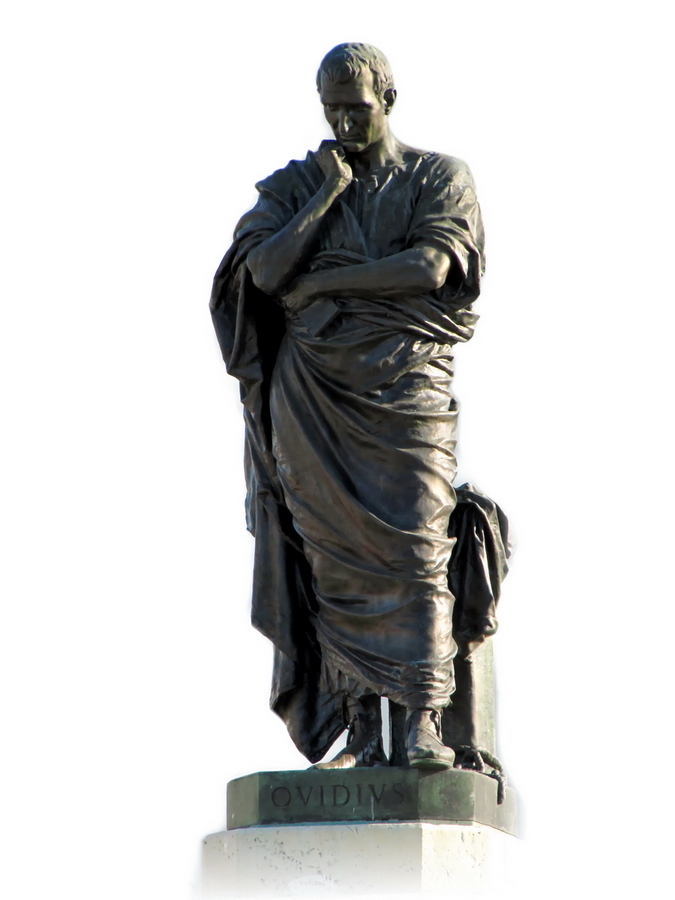
Ferrari, statue of Ovid (Constanța, Romania, 1887)
Study Guide for Exam #2 (Wednesday, March 27)
Latin literature quiz: https://quizgecko.com/quiz/how-well-do-you-know-latin-literature-2Dqg1Y
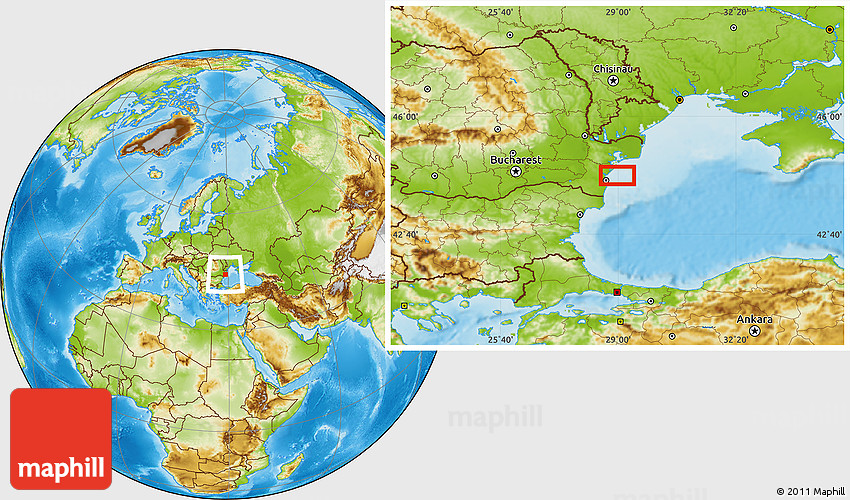
Publius Ovidius Naso (43 BCE-17 CE): Sulmo (Abruzzo, east of Rome), studies in Rome & Athens; abandons civil career ("How long must I go on hearing the same old cant: get a real job, Ovid . . . go to law school", 1.15.3ff.); joins circle of Messala; exiled to Tomis (Constanța, Romania, 8 CE) by Augustus for carmen ("poem”; Ars Amatoria/Art of Love?) et error (“an indiscretion"); exile poetry (Tristia, “My Sorrows”)
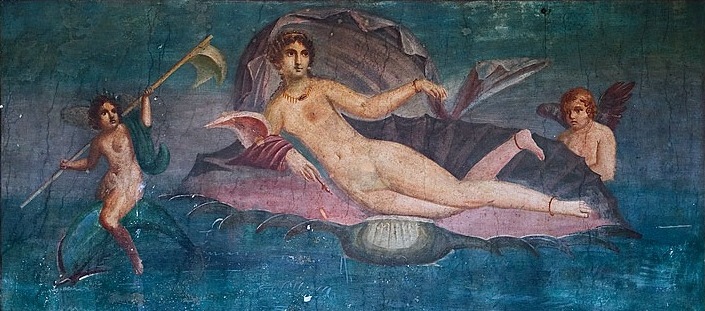
Venus Anadyomene ("rising up") (Pompeii, 1st century CE)
- Amores (“Loves”/“Love Affairs”): published in multiple editions after 20 BCE (3 books as late as 1 CE); late Augustan poet(ry) removed from civil wars & settlement; virtuoso poet scaling hierarchy of genres (love-elegy > epic)
Amores 2.18.5ff. (playful recusatio addressed to poet Macer)
While your magnum opus builds to the heigths of wrathful Achilles
and you fit the sworn confederates with arms
you'll find me, Macer, cooling my heels in Venus's shadow
with Cupid calmly squelching my pretensions
to grandiosity.
I've tried telling Corinna to get lost;
she comes right back and sits down in my lap.
I've told her, "I'm ashamed"; she bursts into tears, and moans,
"are you ashamed of love? ashamed of me?" [Corinna = elegy]
Then she twines her arms around my neck and kisses me
until it's hopeless; I lose all control,
I'm vanquished utterly; I no longer have the slightest concern
for Arms and the Man; I want that woman's arms!
- metapoetic farewell to elegy (sphragis of Amores 3 books): "Mother of gentle Amores, find yourself another poet: / my elegies have run their final race . . . [canonizes himself with Vergil and Catullus as Italian poets] . . . Horned Dionysus moves me now with his solemn thyrsus; / my horses' hooves must strike on new terrain. / Farewell, tender elegies, and you my joyous Muse—my work / and fame will long outlast my little life" (3.15.1ff.)
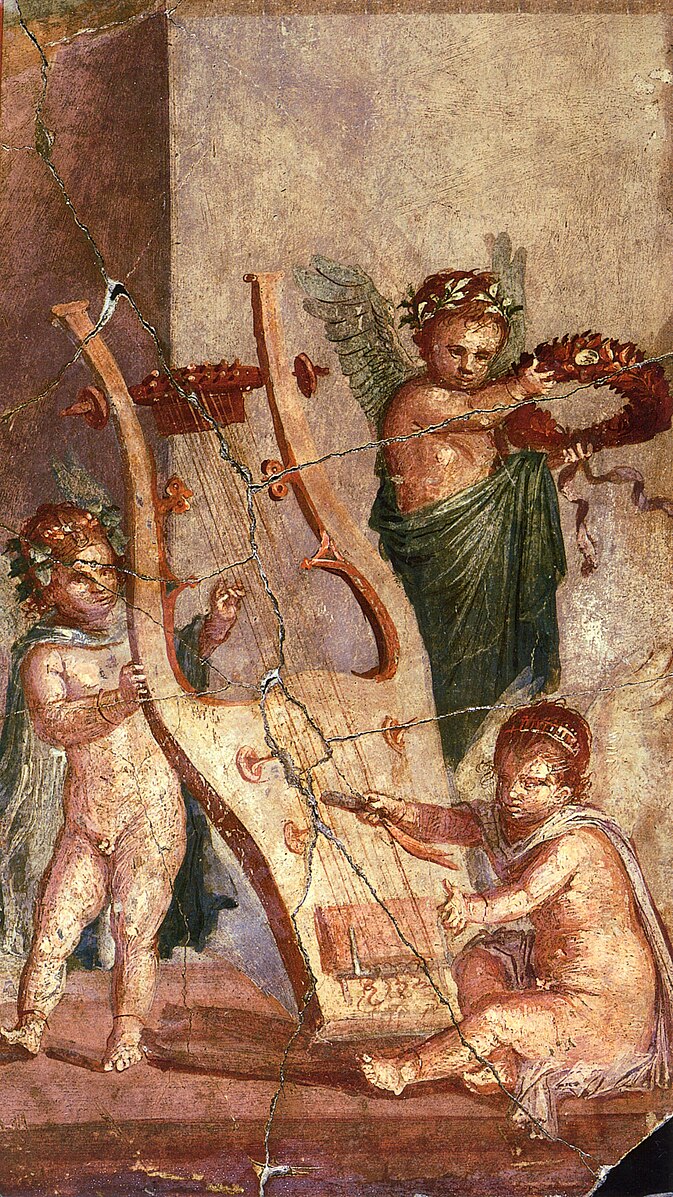
Cupids playing a lyre (Herculaneum, 1st century CE)
- Amores: Alexandrianism; elegiac poems (secret rendezvous, complaints, etc.) with humorous treatment of conventions + speaker's irreverence, self-defeating incompetence, ironic distance from emotions, meta-literariness, etc.; nugatory or idiosyncratic pieces (e.g. 1.4, dinner party instructions; 1.6, paraclausithyron to chained doorkeeper, not door; 1.14, hair-dye disaster; 2.14, abortion poem)
- Corinna rarely mentioned (cf. Greek (choral) lyric poet, Boeotia); love for Corinna not a matter of life & death
- programmatic opening: (love?) poet not already in love – negotiating poetic genres/genre hierarchy
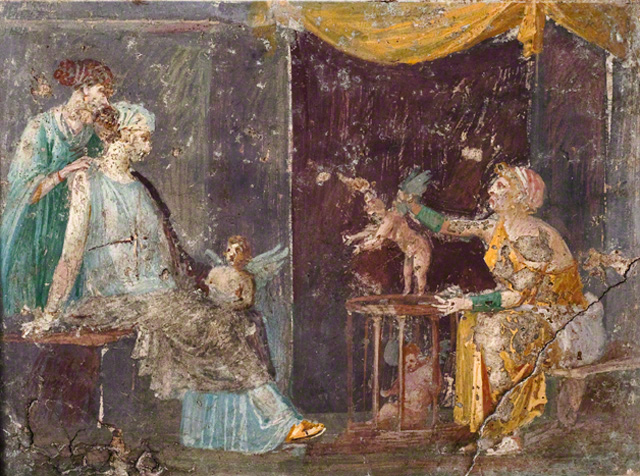 Woman selling Cupids (Villa di Arianna, Stabiae, 1st century BCE)
Weapons and war were my theme. I was ready to roll forth battle lines [first word arma]
in meter to match my subject matter.
Ranks of verses stood in strict formation—when Cupid laughed
(it’s said) and stole a foot of hexameter. [dactylic hexameter > pentameter]
'Barbarous boy, who gave you leave to meddle in the art of poetry?
It’s the Pierides, not you, we bards flock to.
What if you caught Venus trying on the breastplate of blond Minerva,
or blond Minerva fanning the flames of love? . . .
[examples of other gods out of bounds, ". . . do you rule the whole world?", 12)]
. . . Don’t you see I haven’t the themes light verse is made of: no boy
or girl with her hair nicely done up.' [metonymy for elegy]
So I complained. He just reached into his opened quiver
and found the arrow meant for me.
He stoutly gripped his bow and bent it back against his knee:
'Here’s something,' he said, 'to make you sing.'
O unhappy me! That boy really knew how to use a bow and arrow!
I’m on fire—Love’s taken charge of my heart.
Now let my verse swell with one line and fall back with the next.
Farewell war and iron-shod hexameters!
Muse, now bind your fair forehead with myrtle from the shore,
and prepare to dance a different tune. [speaker's "beloved" not named until 1.5!]
[*Cf. Aetia prologue:
In fact the very first time I put the writing tablet
on my knees, Lykian Apollo said to me:
"[...] poet, nurture your sacrificial victim to be as fat as possible,
but your Muse, O good fellow, to be slender!
One more thing, I enjoin you this: the paths that wagons don’t drive on,
tread on those, don’t drive your chariot in the same tracks as the others,
don’t take the broad street, take instead unworn paths
even though you drive on a narrower road."]
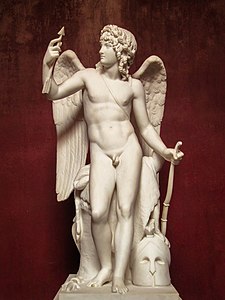
Thorvaldsen, Cupid Triumphant (1898)
- parodying elegy's conceptual metaphors (servitium amoris, militia amoris) in triumphal song; socio-political subversion?
Amores 1.2.19-42 READER: Nora
Cupid, I acknowledge now that I’m your latest battle spoils,
You set the terms, I hold out my hands, defeated.
No need to start a war. I pray for an armistice and clemency;
there’s no fame in conquering an unarmed man.
Bind myrtle in your hair. Go bridle your mother’s sacred doves;
your stepdad Vulcan will custom build your car.
In it you’ll ride in glory. The Roman people will roar ‘io triumphe!’
as you expertly guide the harnessed birds.
Your captives, men and women in youth’s flower, will be paraded
in your magnificent triumphal procession.
And there I’ll be, my wound still fresh for all to see, you latest prize,
in unaccustomed chains, my heart your slave.
Good conscience, her hands bound behind her back, and Decency, [Mens Bona, Pudor]
and all Love’s enemies will be paraded.
You terrify the world. The multitude lifts up its arms, salutes you,
and with a mighty voice will chant ‘io triumphe!’
Your faction’s stalwarts flock along beside you: the ranks
of Blandishment, Misstep, and Mania. [Blanditiae, Error, Furor]
With soldiers like these you subjugate the human race and the gods;
without such reinforcements, you’d be exposed.
Your mother, watching from high Olympus, applauds your triumph
and showers rose petals down upon your head.
[final couplet (re Cupid's clementia), "take a lesson from Caesar, your kinsman, and his auspicious arms: / the hand that conquers shields the ones it vanquished"]
- the comic/didactic (feckless!) praeceptor amoris ("love doctor") versus fearful/jealous elegiac lover: mistress still not named!
Amores 1.4.13.40 READER: Melia
First, find an excuse to come before him—I really don’t know
what good it will do—but do it anyway.
Look the part of dutiful wife when you follow him to the dining couch,
but rub against my foot as you pass by.
Watch me. I’ll communicate by nods, the look on my face:
decode my winks and secretly reply.
Who needs speech? What can’t I say with the arch of an eyebrow
or trace with a finger in air or wine?
When you find yourself thinking of our latest lovemaking,
touch your flushed cheek with your thumb.
If you’re brooding over some wrong you think I’ve done,
let me know by pinching your earlobe.
But darling, if I say or do anything that gives you pleasure,
encourage me by twiddling your ring.
When you’re praying that he will suffer his just deserts, touch
the table as a suppliant would an altar.
Be wise and make him swallow the drink he mixed for you; calmly ask
the slave to bring whatever you want.
When you’ve taken a sip and put down your glass, I’ll snatch it
and press my lips to the wet rim.
If he thinks to pass the hors d’oeuvres he’s sampled,
turn up your nose at what he tasted.
Push him away when he tries to embrace you; don’t rest
your head tenderly on that tough chest.
Keep his hands out of your dress; shield your inviting breasts;
make it clear there will be no kissing.
Kiss him once and you can forget this masquerade; I’ll shout
“she’s mine” and throw my arms around you.
[final couplet (begruding sex with rival), "But whatever happens during the night, tell me the next day / that nothing happened, and make me believe it"]
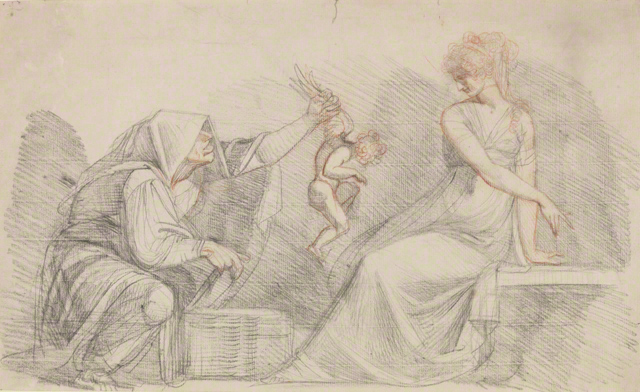
Fuseli, Cupid Seller (chalk drawing, 1775)