CLAS 301B
April 15, 2025

Creative Projects (due tonight in D2L)
Lucan, Civil War (cont.)
Civil War 7 (outline): Pompey's dream (7.9ff.) of theater in Rome (narrator laments loss of public funeral); pre-battle speeches – Pompey hesitant ("the warlord's gloomy words / Set fire to their spirits", 7.416-17), Caesar impatient & impious ("Even if you see parents / In the enemy's ranks, mutilate their sacred faces / With your steel", 7.342-4); battle at Pharsalus (Pharsalia) & aftermath

Dead Germans in trenches (WWI Battle of the Somme, 1916)
- narrator's apocalyptic despair as battle commences: laments indifference of gods, Rome's lost libertas, bleak vision of future, recurrent nightmare of Roman history & deep time consequences (Lucan's anti-Aeneid)
Civil War 7.422-5
They'll inflict
wounds that no future age can heal,
Though it be free from war forever. Their battle
Will bury unborn races, sweeping aside an entire
Generation of people yet to be born to the world.
Civil War 7.473-82 (Rome's permanent enslavement to kings)
And Liberty,
Shunning civil war's atrocities, has fled
Beyond the Tigris and Rhine, to never return
No matter how much blood we spill for her.
She's now a blessing for Germans and Scythians
And doesn't care any more about Italy at all.
O how I wish our people had never known her!
And that Rome had remained in slavery
From the beginning, from when Romulus
Inaugurated his city with a vulture's flight
And filled its walls from the infamous Asylum!
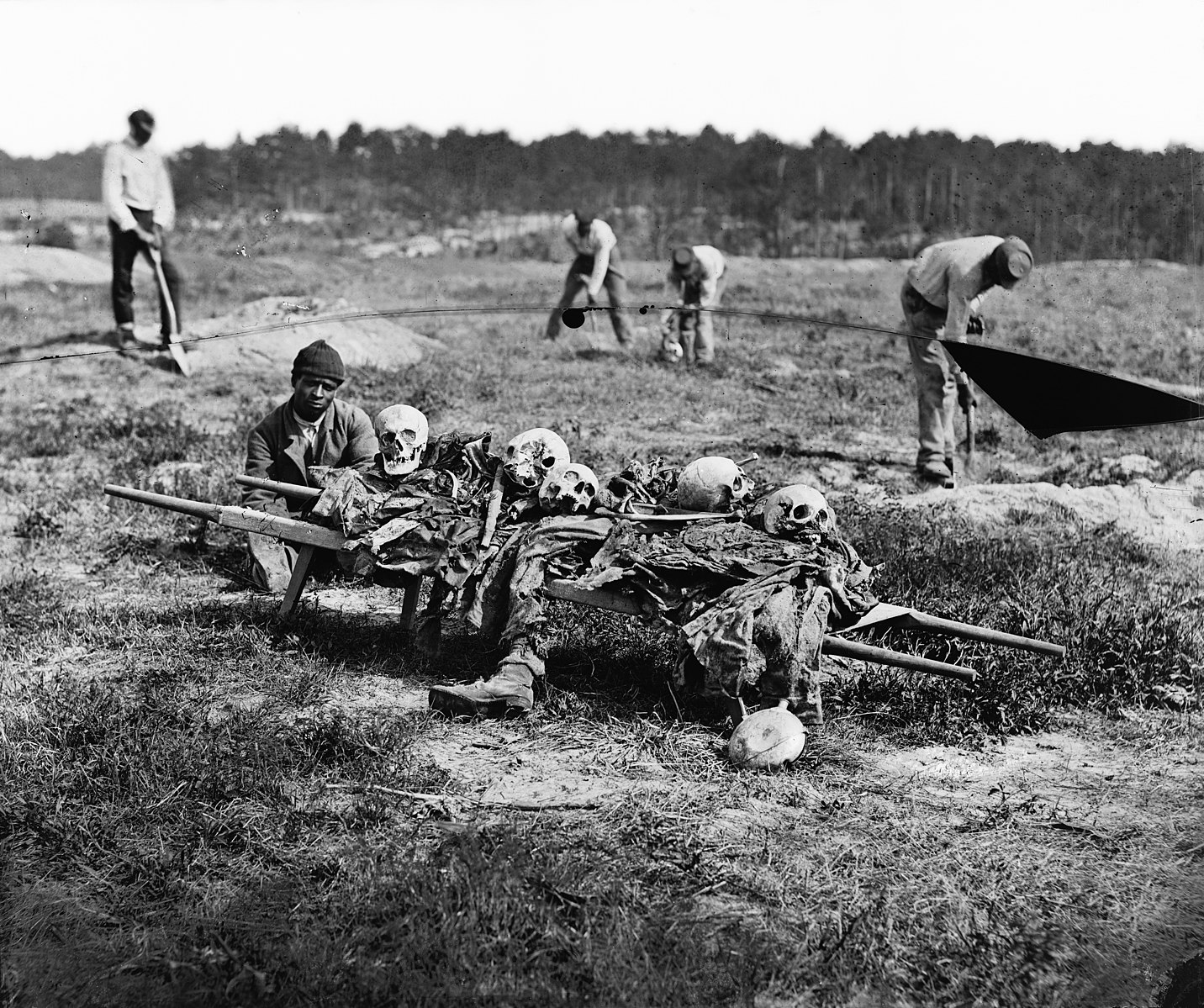
Collection of civil war dead (Cold Harbor, VA, 1865)
- reluctance & horror at task of narrating civil war
Civil War 7.611-17 (after battle of Pharsalus commences)
O Caesar! Here's your madness, your frenzy,
Your crimes! O mind! Flee this part of war
And leave it in darkness forever! Let no age
Come to learn such horrors from my pen,
Or how much license is granted in civil war.
Better that these tears and protests perish.
What Rome did in this struggle I'll never tell.
- narrating civil war's deaths: anti-epic/anti-aristeia
Civil War 7.687-716 (anonymity of civil/world war)
When the whole world is dying, it's shameful
To waste tears on countless deaths, to follow
individual fates and ask through whose guts
Each death-stroke passed, or who trampled
His own entrails as they spilled on the earth;
Who looked his foe in the face and thrust
Sword from throat with his dying breath;
Who toppled when stricken, and who stood tall
As his limbs fell about him. It's shameful
To seek whom spears passed through, and whom
They fixed to the plain; whose blood burst
From veins into air and drenched the arms
Of his enemy; who hacked his brother's breast
And cast his severed head away to plunder
The corpse; who mutilated his father's features
With brutal rage to convince his watchers
That he hadn't just butchered his parent. [cf. "Wars . . . worse than civil", 1.1]
No death alone deserves its own lament,
And we don't have time to mourn individuals.
Pharsalia wasn't like any prior battle's catastrophes:
There Rome perished through men's deaths,
Here through entire peoples'. Not soldiers,
But whole nations died. Here blood streamed
From all Greece and Pontus and Assyria—
Before a huge flood of Roman gore stopped it
From scabbing over the plains. This battle
Wounded mankind
worse than any one time
Could take. And more than life and safety died.
The entire world was made prostrate forever.
These swords damned every later age to slavery. [Anti-Aeneid]
- Pompey flees rout ("It wasn't battle: / One side raged war with swords, the other / With bare throats", 7.591-3): narrator's spinning sententiae, "And once you left the war / The dying Senate showed it had fought for itself" (7.781-2),"It was worse to win" (7.792)

- Caesar has soldiers plunder camps: remorse & nightmares, "but all ghosts fall on Caesar", Ides of March forecasted (7.869ff.)
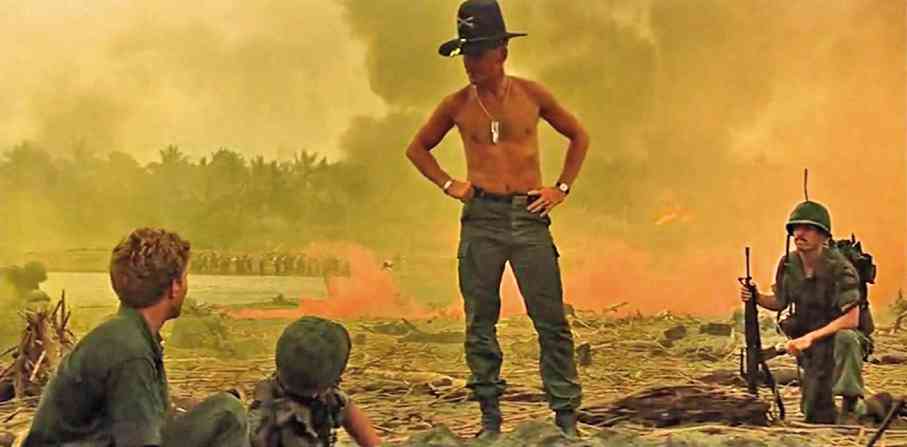
Lt. Col. Bill Kilgore (Robert Duvall), "I love the smell of napalm in the morning", Apocalyspse Now (1979)
- Caesar's Breakfast of Champions – views morning-after spectacle/grotesque theater of war
Civil War 7.878ff. (Caesar surveys battlefield)
When clear daylight unveiled Pharsalia's losses
Caesar's eyes were glued to the deathly fields.
The look of the place doesn't stun him. He sees
Rivers rushing with gore and massed corpses
Piled high as hills. He watches the heaps settle
Into corruption, counting Pompey's allied people.
And a place is set for his breakfast from where
He can note the faces and features of the dead.
He likes not seeing Thessaly's lands, and scanning
With his eyes fields buried beneath the carnage.
He sees his fortune and his gods in the blood.
And loathe to lose his crime's pretty spectacle,
He refuses, in a fit of rage, to grant the wretched
To the pyre's flame, and thrusts the sight of Thessaly
On guilty heaven . . .
. . .
His rage still hasn't savored
Enough slaughter, and he remembers the dead
Were fellow citizens. O Caesar! It's not single pyres
We're after, or separate graves. But grant one fire,
At least. Let nations burn with indiscrete flames. [narrator begs for holocaust]
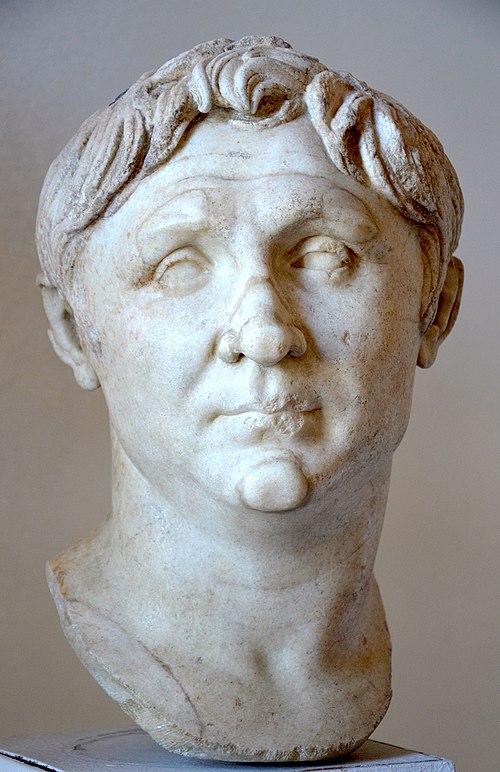
Pompey (70-60 BCE)
Civil War 8 (outline): Pompey in flight, reunited with Cornelia in Lesbos, decides to flee to Egypt (8.1-499); murder plot – Ptolemy (63-47 BCE), brother of Cleopatra VII, eunuch advisor Pothinus, general Achillas, Septimius (“That a Roman sword thus obeyed a foreign king. / And that a boy, Magnus, hacked off your head / With a blade once your own", 8.648-50)
- devoted Cornelia (born ca. 75 BCE): "O husband! It's my wicked fault! / I killed you!" (8.684-5; cf. "Now twice I've ruined / The world", 8.95-6); watches death ("dreading . . . Pompey might kneel / And grovel before the sceptre his hand had given", 8.632ff.), ship flees before beheading
- Pompey's tragic death (September, 48 BCE): poem's Stoic rehabilitation – fuzzy nostalgia & revolutionary icon for Lucan's day? final violation of body politic
Civil War 8.711-25 (Pompey's beheading)
But as the sword-stroke rang against the back
And breast of Magnus, his reverent features' sacred
Beauty never faltered. And though he grimaced
At the gods, death's last moment changed nothing
Of the man's noble bearing—or say those
Who saw the severed head. For brutal Septimius,
Committing the crime, invented a crime much worse.
Ripping back the cloak, he laid bare the holy face
Of half-dead Magnus. He seized his breathing head
And stretched its drooping neck
across a bench.
Then he cut the veins and muscles, hacking long
And hard at knotted bones. To spin heads quickly
Was not yet an art. But after the severed neck
Broke free from the trunk, Achillas claimed the right
To carry it in hand.
- loyal Cordus provides humble moon-lit pyre, funeral, eulogy ("HERE LIES MAGNUS", 8.852); narrator chastises Rome for not returning ashes (8.895ff.)

Cornelia & Pompey in Rome
death of Pompey in Rome: https://www.youtube.com/watch?v=k3buhlYVLOs

Libyan Desert landscape (2021)
Civil War 9 (outline): Stoic soul of Pompey’s journey across cosmos & into Brutus & Cato ("demigods, gathered as soul / For eternal spheres, dwell in open distances / Between the earth and moon. Fiery virtue / From pure lives enables them to endure the low heavens", 9.7-10); shift to Libya (Cato, Cornelia, Pompey's sons); Cato's mixed (honest) eulogy (e.g. "Though he ruled the Senate, the Senate still ruled . . . now that Pompey's gone, even freedom's fiction / Has perished", 9.194ff.); Libyan excursuses (Sandbars/Syrtes, Medusa & poisonous snakes, climate); Cato's march; Caesar the tourist at Troy, Caesar in Egypt

Guillaume Guillon-Lethière, The Death of Cato (1795)
- Cato: Stoic superhero – un-centered hero of unheroic epic or tragicomic Stoic parody? cf. Cicero, Letters to Atticus 2.1.8, "Cato speaks as if he's in Plato's Republic, not Romulus' cesspool"
- narrator: Cato as nostaligized leader of lost cause
Civil War 9.26-9 (Cato embraces leadership role with Pompey's defeat)
Restoring swords abandoned by cowardly hands
And waging civil war without lust for power
Or fear of slavery. He attempted nothing for himself:
After Magnus' end all men fought for freedom.
- Cato as martyr of Republic/lost cause (Lucan's day)
Civil War 9.618-22
Here's the real father of the fatherland, Rome
A man more worthy of your altars. To swear by him
Would cause no shame. And if you ever rise up,
Now or later, and break the yoke from your neck,
You'll make him a god.
- Cato’s fearless march as test of Stoic virtue (vs. Sandbars)– rejects oracle of Ammon, "Our Creator told us at birth / Everything we're permitted to know", 9.589-90)
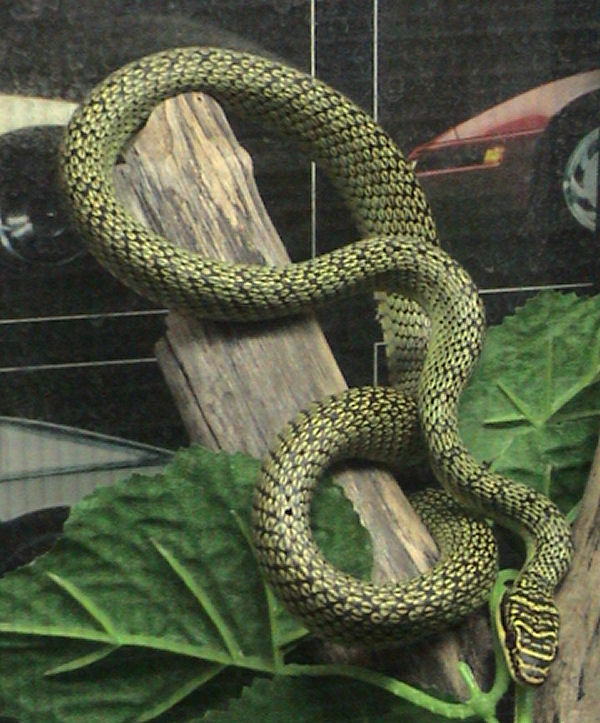
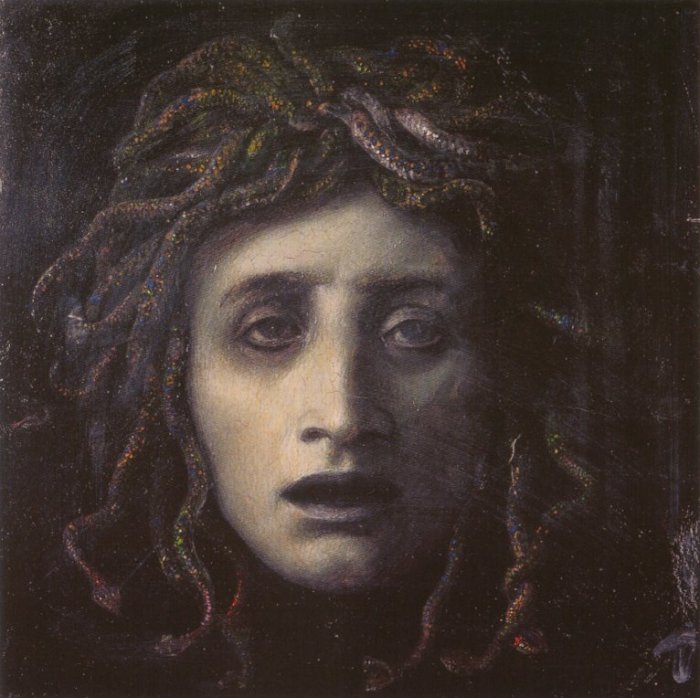
L: Chrysopelea ornata ("flying/gliding snake"); R: Böcklin, Medusa (1878)
- Libya's snakes, Lucan's gothic epic of horror: Cato Stoically oversees grotesque catalogue of horrific deaths/parody of epic battle (e.g. iaculus, "Straight into Paulus' head and out his temples. / Poison played no part, for death was in the wound", 9.839-40; dipsas, "thirst-snake", makes Aulus "Open his swelling veins to swill his own blood", 9.774; seps, "rotting snake", reduces Sabellus "into a corrupt broth / Of concentrated death", 9.792-3); Cato's Stoic test (water rules)
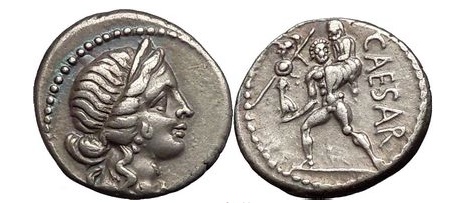
L: Venus; R: Aeneas & Anchises (silver denarius minted by Julius Caesar, 47-46 BCE)
- Cato's troops reach Libya for winter; Caesar as disrespectful tourist at Troy despite Julio-Claudian propaganda; builds altar & promises Troy redux, "Italy will rebuild Trojan walls, and Roman Troy / Will rise again" (9.1026-7), Caesar's vanity building project – Lucan's invention
- Troy & poetic memory in epic – implications for Caesar
Civil War 9.1006-27 (poet’s ironic pledge of immortality)
O great
and holy work of poets!
You rob death of everything, granting eternity
To mortal men—but don't envy their sacred fame,
Caesar. For if Roman Muses can promise anything,
As long as honor endures for Smyrna's Homer,
The future will read you and me, and our Pharsalia
Will live, not damned to darkness by any age.
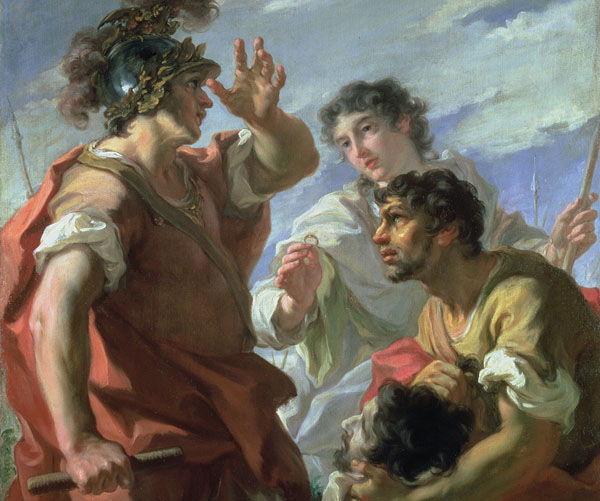
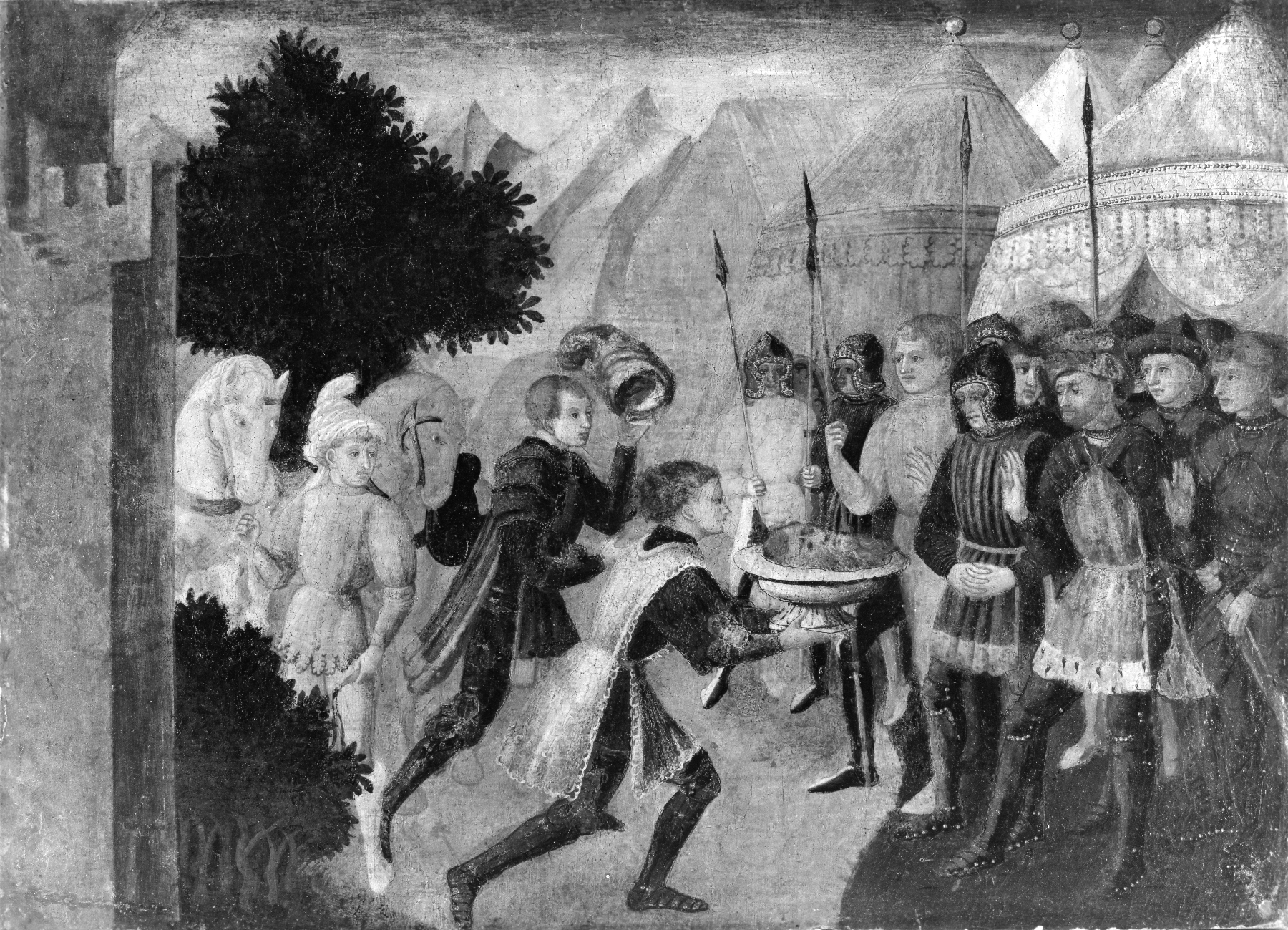
L: Tiepolo, Caesar Contemplating Pompey's Head (ca. 1740); R: delivery of Pompey's head to Caesar (Florence, ca. 1450)
- Caesar in Egypt: revelation of Pompey’s head, crocodile tears (This man had trampled / The Senate's limbs with a slate-blank face, / And stared dry-eyed at Pharsalia's carnage, / Yet you alone, Magnus, he didn't dare not grieve", 9.1075-8), laments lost opportunity to bestow "civil war's sole prize" (clementia, 9.1102) & pardons Ptolemy
display of Pompey's head in Rome: https://www.youtube.com/watch?v=s5Pr1V6_N3c
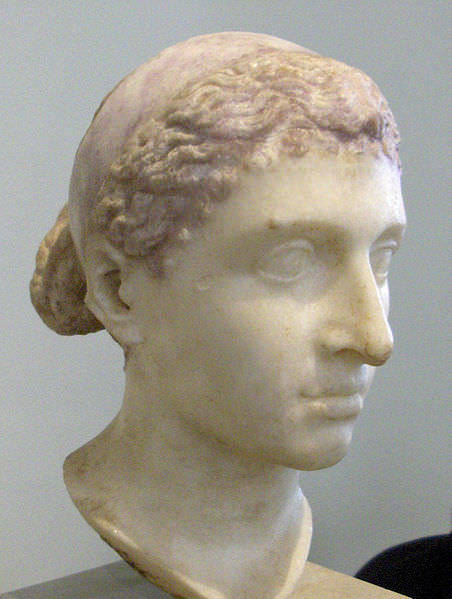
Cleopatra VII (40-30 BCE)
Civil War 10.1-564: Cleopatra's alliance with Caesar; plot against Caesar
Civil War 10.556-64 (Caesar hemmed in at Pharos)
Then and there,
Without routed armies or massive heaps of carnage,
Without bloodshed at all, Caesar could have fallen.
Trapped in place, he hesitates, stalls, uncertain
Whether to fear or pray for death, then catches sight
Of Scaeva in the tight throng—fierce Scaeva,
Who'd earned eternal glory on your fields, Epidamnus,
Where all alone, with the battlements breached,
He guarded the ramparts being trampled by Magnus.
- possible ending of Lucan's epic? Battle of Thapsus (Tunisia) & suicide of Cato (46 BCE)? Battle of Munda, Spain (45 BCE)? Julius Caesar's assassination, Dictator in perpetuum (44 BCE)?