CLAS 301B
April 29, 2024
Paper #2 Topics (due Wednesday, May 1, 11:59pm in D2L)
Study Guide for Final Examination (Friday, May 3, 1:00-3:00pm)
*Creative Projects?*
Petronius (d. 66 CE): suicide & letter @Tacitus, Annales 16.18-19 – Nero's decadent elegantiae arbiter ("judge of taste"); consul (62 CE)
- Petronius' Satyricōn (sc. libri) or Satyrica ("satyr stories"; cf. satura and Roman "satire"): complex parody (via "low" realism & satire) of Greek novel/romance (e.g. Chariton, Achilles Tatius, Heliodorus, Longus)? cf. Menippean satire (e.g. Seneca's Apocolocyntosis) = mix of prose & poetry (prosimetron)
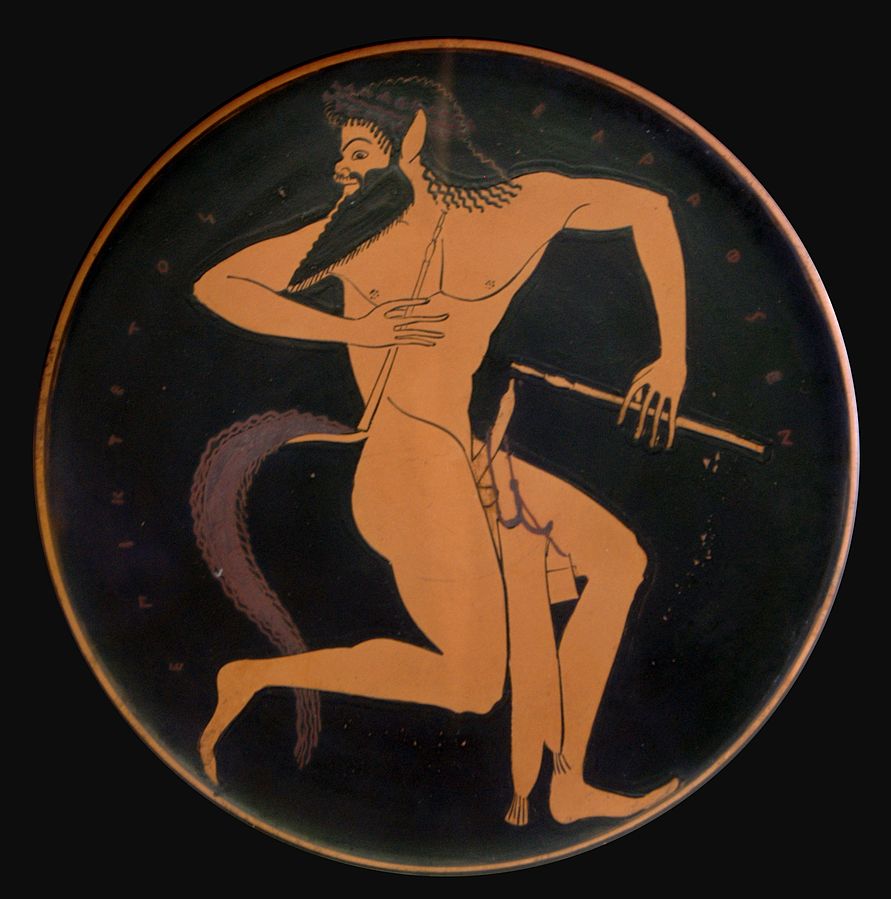
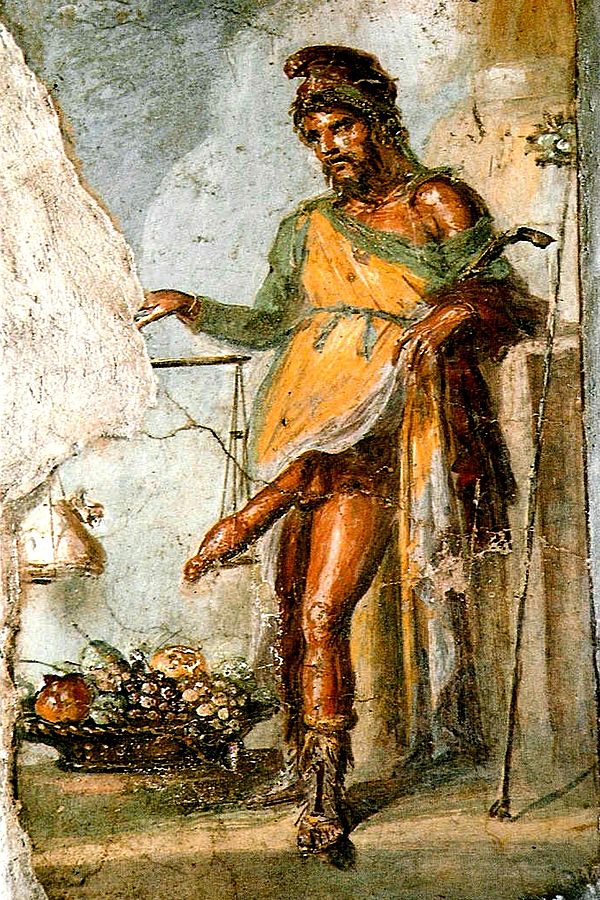
L: Silenus/satyr (Attic red-figure plate, ca. 520-500 BCE): R: fresco of Priapus (Casa dei Vettii, Pompeii)
- satirical Roman Odyssey of sexual (mis)adventures, impotent "hero" Encolpius ("In-Crotch") harried by god Priapus (cf. Odysseus/Poseidon): gritty, un-idealized account of non-elite experience in Graeca urbs (Campania/Bay of Naples)?
- picaresque narrator (first-person memory) & friends pass through Roman/Italian social settings & classes (e.g. markets, rhetorical schools, brothels, etc.) > sophisticated & incongruous appropriation of literary texts & genres – framing of Dinner at Trimalchio's?
- Satyricon subject to loss, excerpting & censorship: Cena Trimalchionis reappears in 17th century; parts preceding & following lacunose – novel's full scope (?)
- Cena: focus on freedmen (lives, colloquial speech, status, personal & class perspectives); uber-wealthy freedman Trimalchio
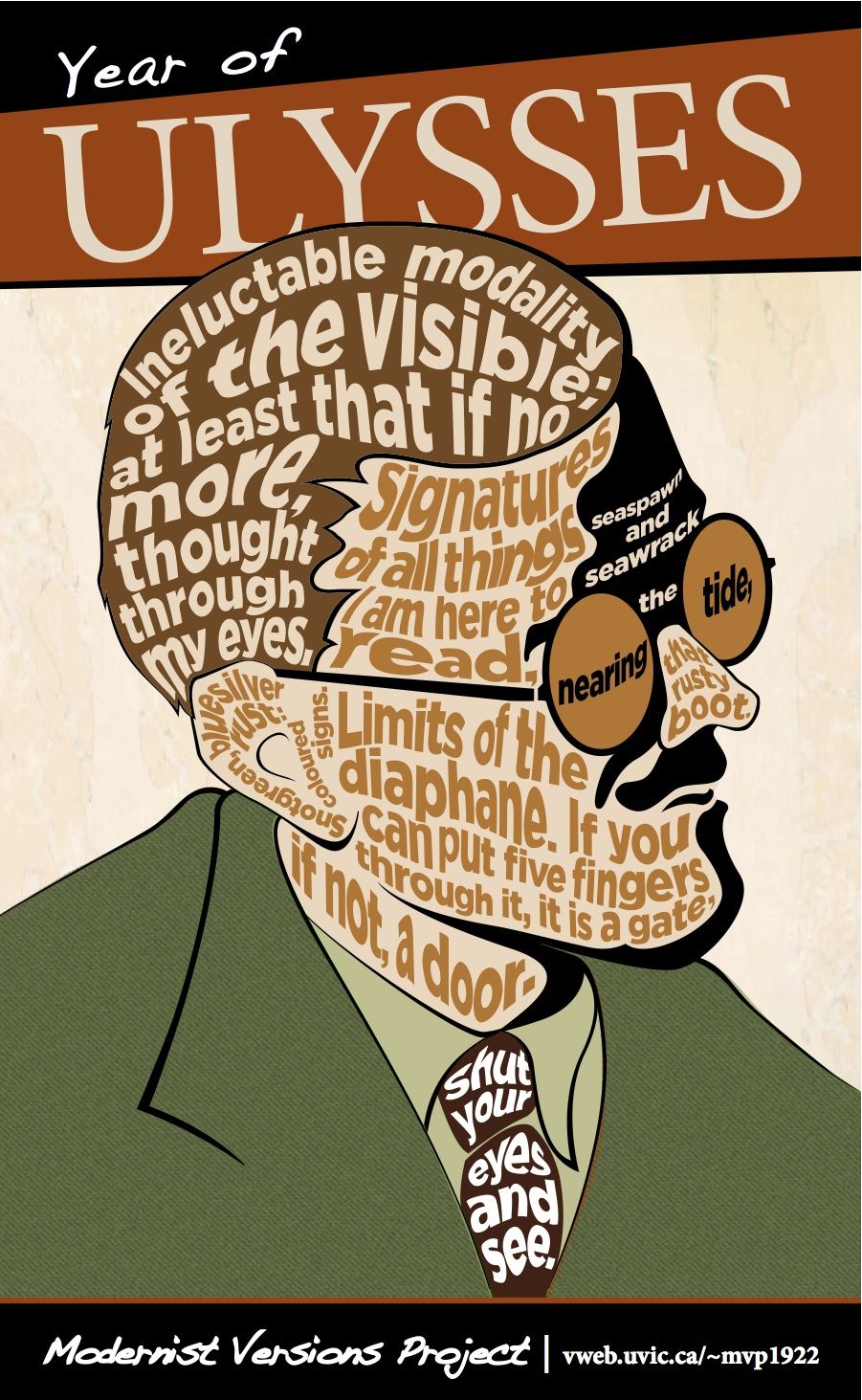
- reception & influence: e.g. F. Scott Fitzgerald's Trimalchio in West Egg, James Joyce's Ulysses, Fellini's 1969 film, et al.
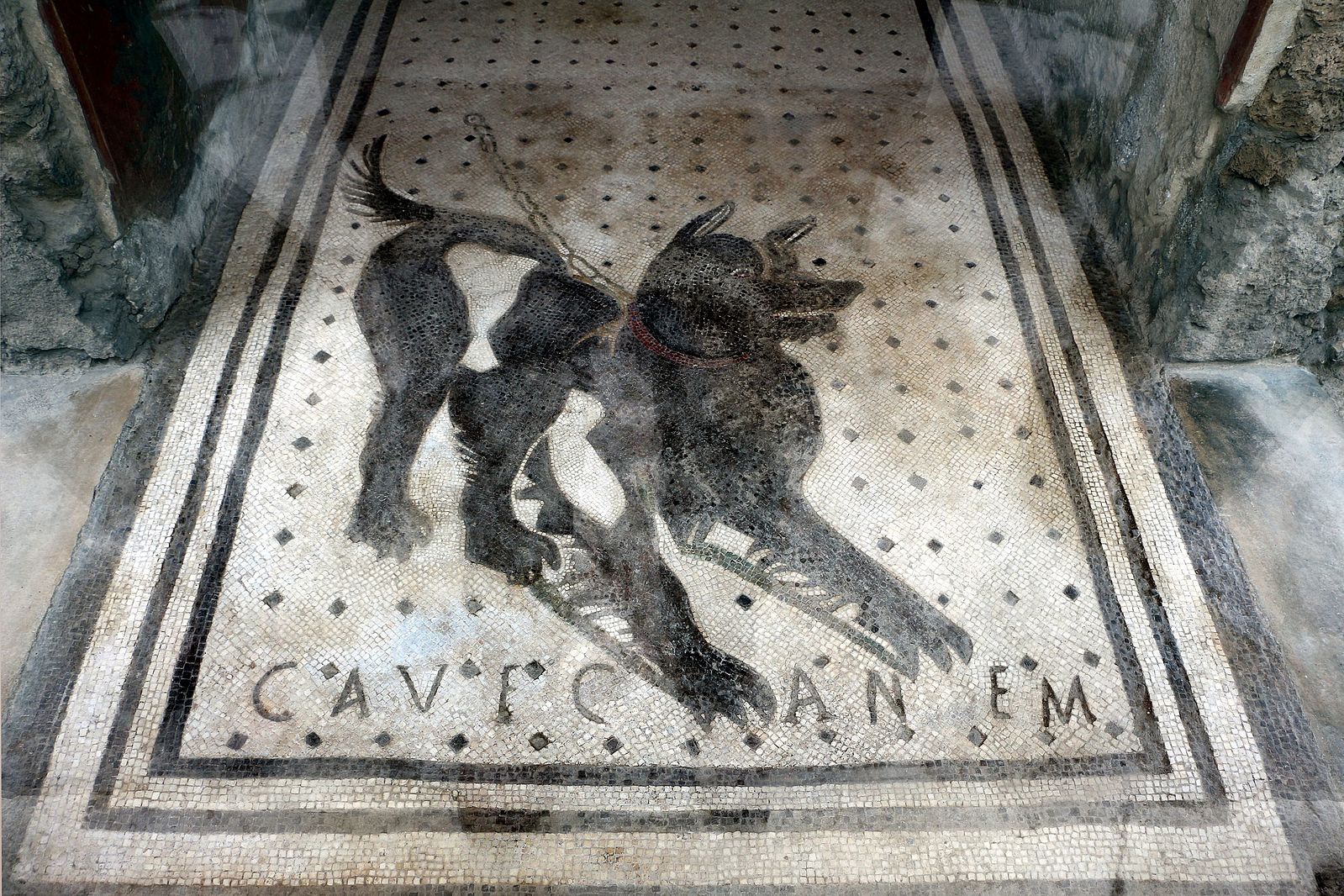
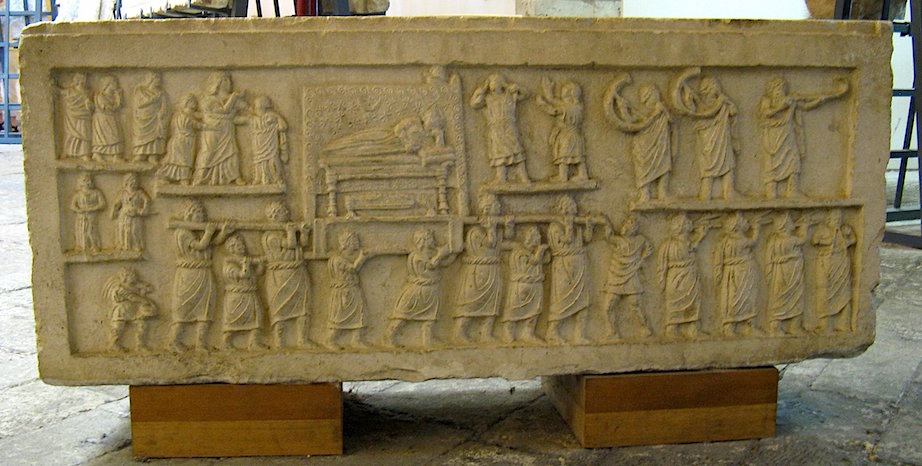
L: cave canem mosaic (House of the Tragic Poet, Pompeii); R: Funeral procession (Amiternum, 50 BCE)
- dinner as katabasis: Trimalchio's funeral & escape from labyrinth/house (random "low" comic ending – firemen?)
Petronius, Satyricon 72-3
Giton had in fact already in the cleverest fashion bought off the dog; he had thrown in front of the barking beast all the tit-bits from the dinner which he had got from us. The dog was distracted by the food, and had quietened down. We were shivering and soaking, and begged the doorman to let us out of the gate. But he responded: 'You're mistaken if you think that you can leave by the same entrance by which you came in. None of our guests is ever let out through the same gate; they come in one way, and go out another.' What were we poor wretches to do, hemmed in as we were in this novel labyrinth?
- character of Trimalchio: personal idiosyncracies, social aspirations & faux pas > performing as elite dinner host
Trimalchio's status & personal history: deracinated Asian, "at the age of fourteen I was my master's favourite—there's no shame in doing your master's bidding. Mind you,I used to keep the mistress happy as well . . . I'm not one to brag"; inheritance; 5 ships lost in first venture, second fleet ("wine, bacon, beans, perfumes, slaves", 76) thanks to Fortunata's help; "There and then I cleared the debt on all the estates which had belonged to my patron. I built a house, put money into slaves and cattle; everything I touched grew like a honeycomb. Once I reached the stage of being richer than the whole community, I threw my hand in, and retired from commerce. I began employing freedmen as agents in money-lending" (76)
Trimalchio's obsessions: wealth, status (e.g. boar wearing cap of freedom, 40), style/costume (colorful clothing), lavish food presentation (un-gutted pig performance, 49), astrology & superstition (witches), time & death (30 yrs, 4 months, 2 days to live, 77)
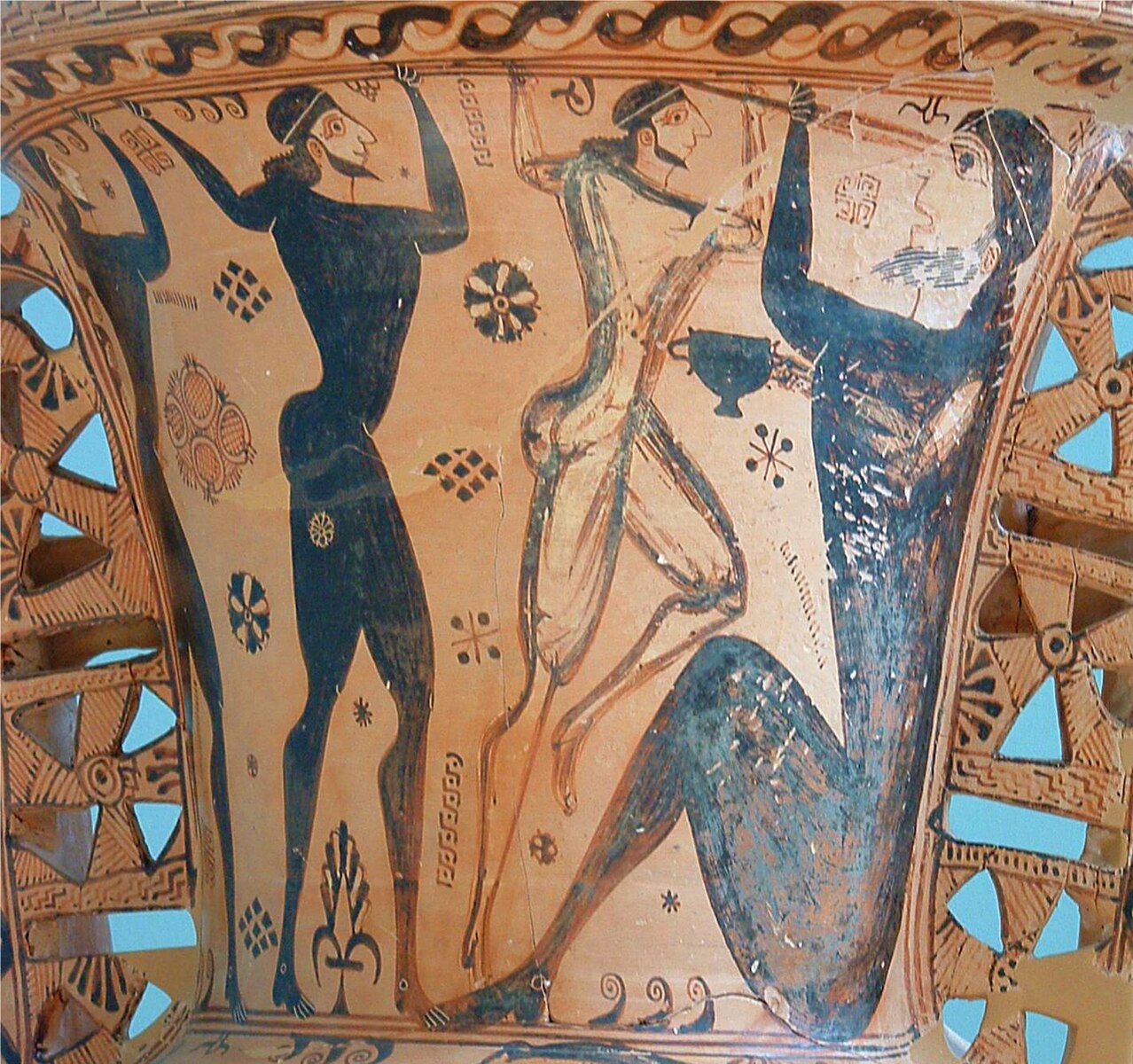
Odysseus & Polyphemus (proto-Attic amphora, 7th century BCE)
Trimalchio's aspirations: pretentious bragging (wealth & power) & "learning" (mythology, literature), e.g. "Ulysses had his thumb twisted off by the Cyclops with his pincers?" (48), silver engraving of "Cassandra killing her sons" (52), "At the capture of Troy . . . Hannibal piled all the statues of bronze, gold and silver on a pyre, and set fire to them" (50)
Petronius, Satyricon 47 (host's dinner exegesis)
'None of us was born rock-solid. I can't imagine any torture worse than having to hold it in. This is the one thing that even Jupiter can't forbid. I see you're grinning, Fortunata, but that's how you keep me awake at night. But even in the dining-room I don't forbid anyone to ease himself, and the doctors forbid us to keep the wind inside. If anything heavier is imminent, everything's ready outside—water, chamber-pots, the other bits and pieces. Believe me, the vapours attack the brain, and flood through your whole body. I know quite a few who've died that way through refusing to face the facts.' We thanked him for his generosity and consideration, and hastened to choke our laughter by taking frequent swigs of the wine.
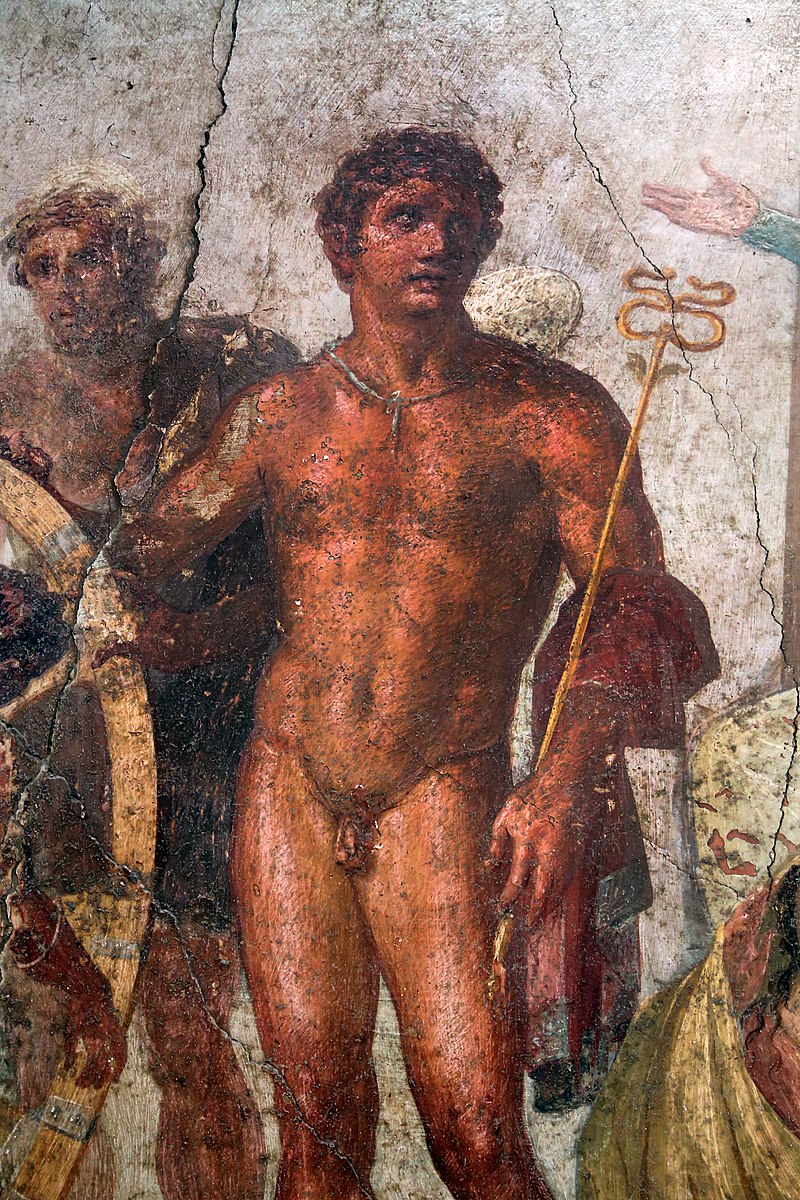
Mercury fresco (Casa dei Vettii, Pompeii)
- Trimalchio's auto-biographical fresco/ekphrasis: mythologizing his life – social death > apotheosis (cf. Mercury Psychopompus, "Guider of Souls")
Petronius, Satyricon 29 (Encolpius recovers from seeing the painted dog)
I gathered my wits, and proceeded to examine the entire wall. There was the representation of a slave market, with placards bearing the names and prices of the slaves. Trimalchio himself was there, sporting long hair and holding a herald's wand; Minerva was escorting him on his entry into Rome. Next the painter had carefully and scrupulously depicted, with commentary below, the detail of how Trimalchio had learnt accountancy, and had then become a steward. At the end of the colonnade, Mercury had raised him by the chin, and was bearing him up on to a lofty dais. Fortune with her horn of plenty was in attendance, and the three Fates were there spinning their golden threads.
- Trimalchio's contradictory style of mastery: inscription, "Any slave leaving the house without his master's bidding will receive a hundred stripes" (28); dinner arrangement to avoid "stinking slaves" (34); slaves join free guests
for will & final funeral scene, (70)
Petronius, Satyricon 64 (following dog-fight & broken glassware)
Trimalchio did not wish to appear irritated by the damage, so he kissed the boy, and told him to mount his back. Croesus promptly played the jockey, and kept striking Trimalchio's shoulders with the flat of his hand. Giggling away, he chanted: 'Buck, buck, how many fingers have I up?' This effort quietened Trimalchio for a time. He ordered a large bowl of wine to be served, and drinks to be distributed to all the slaves sitting at our feet. He added this proviso: 'If anyone refuses, pour it over his head. Harsh discipline by day; now's the time for cheerful play.'
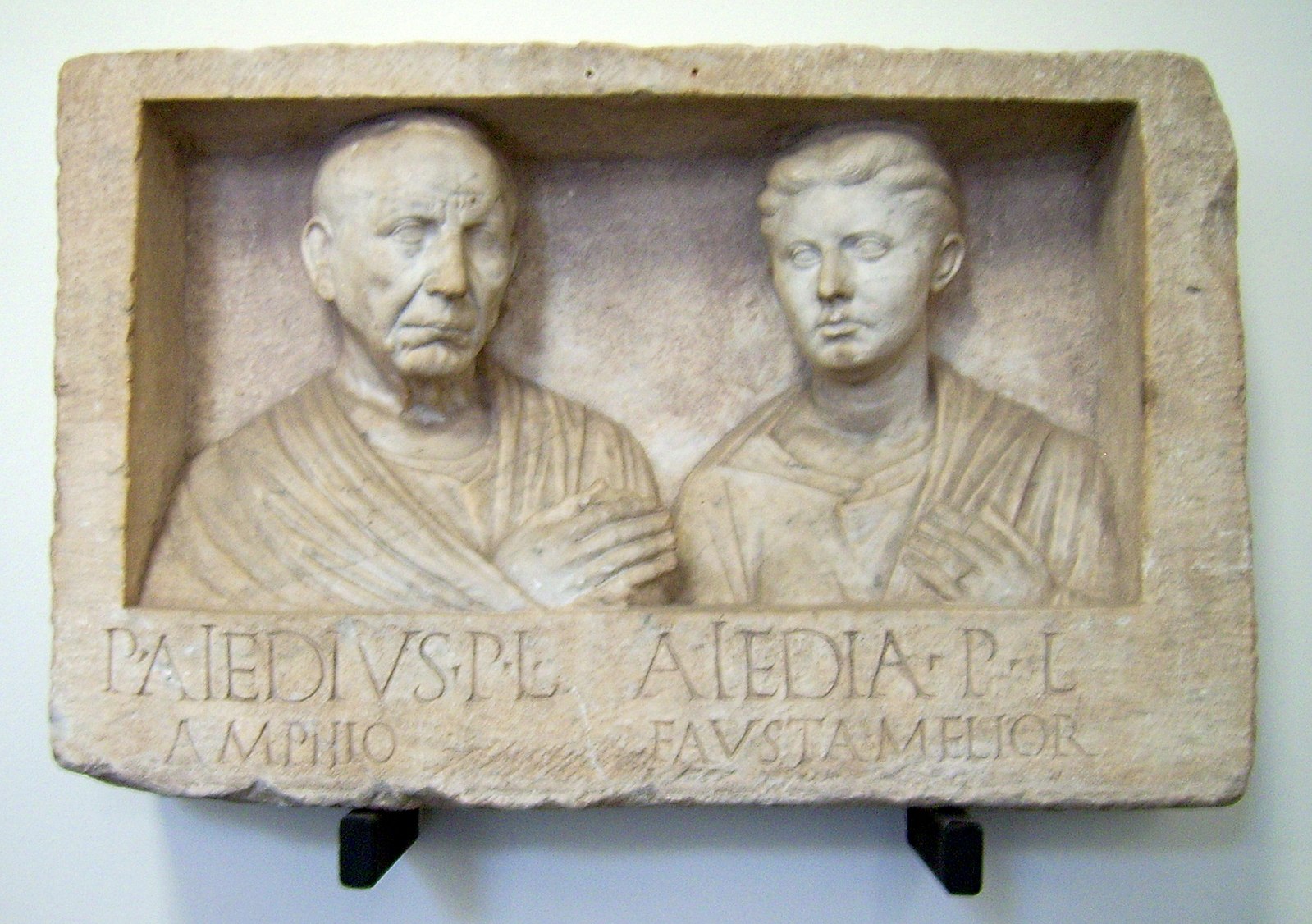
Relief monument of freedpersons P. Aiedius Amphio and Aiedia Fausta Melior (Via Appia, early 1st century CE)
- Fortunata: freedwoman wife of Trimalchio, influential in household (drunk Trimalchio, "Will none of you ask my dear Fortunata to dance? Believe me, nobody does the cordax better", 52)
Petronius, Satyricon 37 (guest's commentary on Fortunata)
'That's Trimalchio's wife,' he answered. 'Her name is Fortunata. She measures her money by the bushel. Yet what was she only a short time ago? You will pardon my saying this, but you wouldn't have taken a bread-roll from her hand. But now—there's no rhyme or reason in it—she's on top of the world, and Trimalchio thinks the world of her. To put it bluntly, if she tells him at high noon that it's pitch dark, he'll believe her. As for Trimalchio, he's so wealthy he doesn't know how much he's got. But that lynx sees to everything. She turns up in the most unlikely places. She keeps off the booze, and she's a steady influence, offering sound advice. But what a forked tongue! She's a real magpie of the couch. If she likes you, she likes you; if she doesn't, she doesn't.'
Petronius, Satyricon 67 (humiliation of Fortunata)
Meanwhile the women were tipsily giggling at each other, and exchanging drunken kisses, as one boasted of her conscientious role as female head of the household, and the other complained of her husband's boy-favourite and neglect of her. While they were engaged with each other in this way, Habinnas quietly got to his feet, seized Fortunata by the legs, and threw her over the couch. "Ouch, ouch!" she cried as her petticoat rose above her knees. She then took refuge in Scintilla's lap, and blushing rosy-red, hid her face in her napkin.
Petronius, Satyricon 74 (domestic abuse after Trimalchio kisses slave-boy)
Trimalchio's reaction was to remark: 'So does my flute-girl not recall that I rescued her from the slave-stand, and made her fit for human company? Yet here she is, puffing herself up like a frog, and giving herself airs. Thick as a plank she is—she's no woman. But if you're born in the shed outside, you don't aspire to the mansion . . . I could have married into ten million though I hadn't a penny to my name; you know I'm not telling fibs. Agatho in the perfume shop took me aside the other day, and said: "I do urge you not to let your line die out." But being a decent sort, not wanting to appear unfaithful, I've shot myself in the foot . . . Habinnas, I won't have you put her statue on my tomb, so that at least when I'm dead I won't have any argy-bargy. In fact, to impress on her that I can do her a bad turn, don't let her kiss me when I'm dead.'
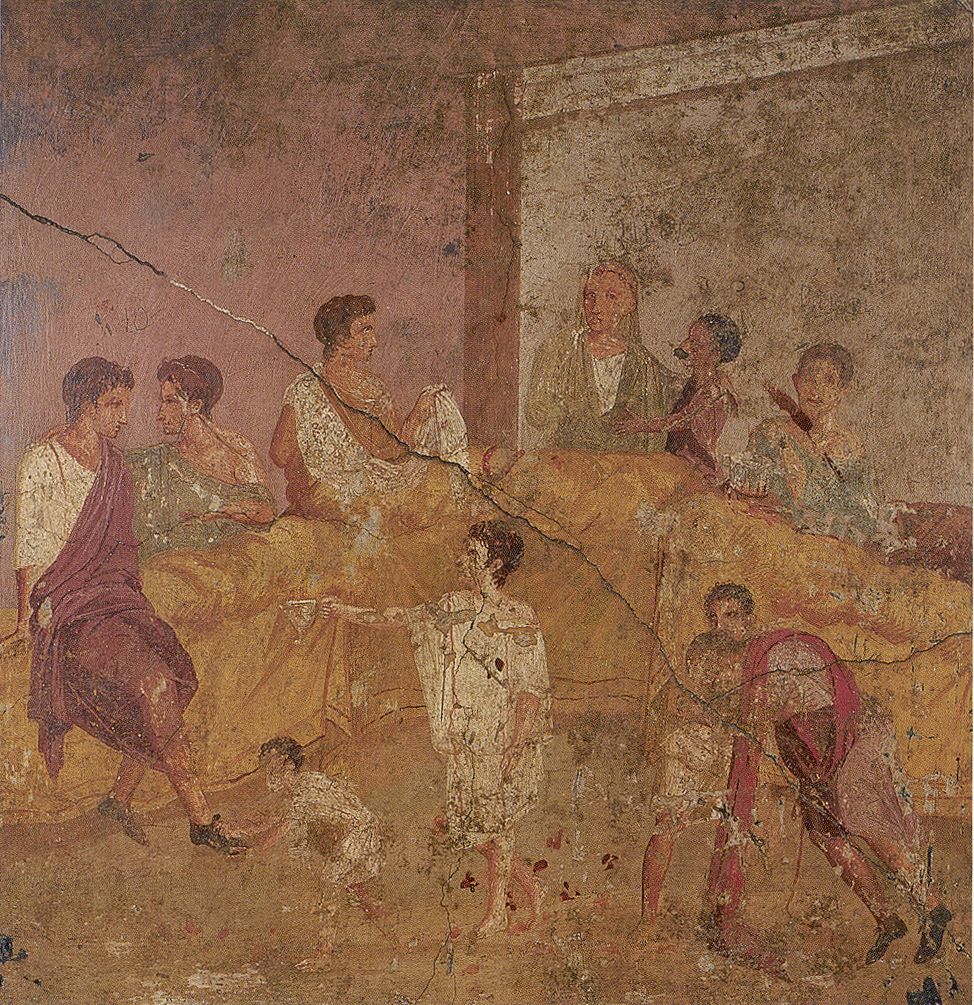
Dinner party, House of the Triclinium (Pompeii, 1st century CE)
- Trimalchio's will: a regular dinner-party performance?
Petronius, Satyricon 71 (Trimalchio's aspirations after death)
'My friends,' he said, 'slaves too are men; they have drunk their mother's milk like the rest of us, even if a malign fate has overtaken them. But so long as I'm spared, they will soon taste the water of freedom. In short, I intend to free them all in my will: I'm also bequeathing a farm and his concubine to Philargyrus, and to Cario a block of flats, his manumission tax, and a bed complete with bedcovers. As for Fortunata, I'm making her my heiress, and commending her to all my friends. I'm making all these arrangements generally known, so that my household can show me now the affection due when I'm dead.' They all began to express thanks for their master's generosity. He then abandoned all badinage, and ordered a copy of his will to be brought in. He read out the entire document from beginning to end, to the accompaniment of lamentations from the household. He then looked over at Habinnas. 'Tell me, my dearest friend,' he said, 'will you order my tomb according to my instructions? My earnest request is that you set my little dog below my statue, and put in garlands, perfumes, and all the contests of Petraites: so that through your kindness my life can continue after death. Build it a hundred feet wide at the front, and two hundred feet from front to rear. I'd like fruit trees of all kinds surrounding my ashes, and lots of vines; it's quite wrong for a man to have an elegant house in life, and not to give thought to our longer place of residence. So before all else I want an inscription with the words "This tomb must not pass to an heir." I'll be careful to stipulate in my will that I come to no harm when dead; I'll appoint one of my freedmen to mount guard over my tomb, to ensure that people don't make a beeline to shit against it. I want you also to depict ships in full sail, and myself sitting on a dais wearing the toga with a purple stripe and five gold rings, dispensing coins from a wallet to the people at large; you know that I laid on a dinner for them at two denarii a head. If you will, incorporate dining-halls as well, and all the citizens having a good time in them. On my right erect a statue of my Fortunata holding a dove, and leading along her puppy with its jacket on. Put in my boy favourite, and some big winejars sealed with gypsum to ensure that the wine doesn't leak out. You can show one of the jars as broken, with a slave weeping over it. Put a sundial in the middle, so that whoever wants to know the time will read my name, whether he wants to or not. Oh yes, and give some thought to whether this inscription strikes you as suitable enough: "Here rests Gaius Pompeius Trimalchio of the household of Maecenas. He was formally declared Priest of Augustus in his absence; Though he could have claimed membership of every Roman guild, he refused. He was god fearing, brave and faithful. He grew from small beginnings and left thirty million, without ever hearing a philosopher lecture: Farewell, Trimalchio; and fare well, you who read this."'
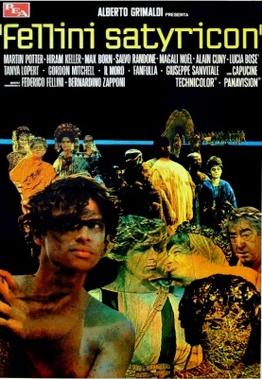
dinner scene from Fellini's Satyricon (1969)
GROUPS