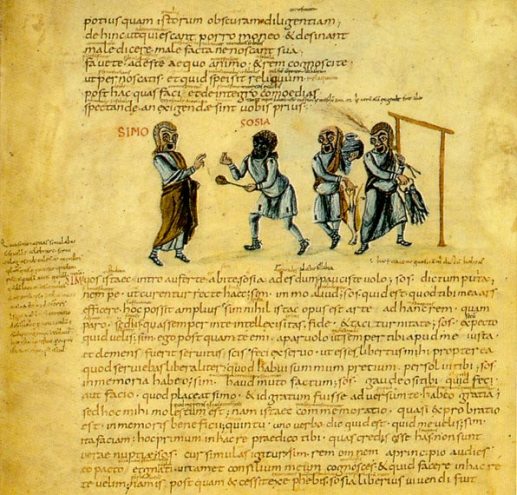
- Prologue: charge of "contamination" (“[Terence] has ‘spoiled’ a large number of Greek plays in writing a small number of Latin ones ... he has no regrets and will do it again. He has the precedent of good writers ...” (16-19); claim of “malicious old author” (21; Luscius of Lanuvium) that Terence “[relies] on the talent of his friends, not his own abilities” (22-3; patronage?); promise of “a quiet play" (36-7; no loud or flashy characters, e.g. parasite & pimp, or stage action); "This play contains words, pure and simple" (46)
- complex plot of misunderstandings, failures of communication, (self-)deception, character
- Title: is Menedemus the main character or Chremes? (“I’m a man; I don’t regard any man’s affairs as not concerning me”, 77; homo sum; humani nil a me alienum puto)
- opening scene outside Athens:
Clinia treating Corinthian woman's presumed daughter (Antiphila, "Love-in-Return"), a non-citizen, "as if she were his wife" (98); Menedemus's reaction?
Self-Tormentor 137-138 (Menedemus's self-punishment)
I
shall spend the whole time punishing myself to make amends to him, toiling away, scrimping and saving, making myself his slave.
Chremes's advice to Menedemus, "But you didn't know him properly ... You never showed him how much you cared for him, and he never dared talk to you about the things a boy ought to discuss with his father" (152ff.); irony?
- Menedemus's problems resolved with return of Clinia (175ff., Scene 2), but resolution delayed by Chremes's controlling & meddling (doesn't tell Clitipho of Menedemus's misery)
Self-Tormentor 198ff. (Chremes moralizes about Clinia to Clitipho)
...
whatever things were like, he should have stayed, Perhaps he was a little less lenient than the boy liked; he should have put up with it ... This is the smart thing to do: make other people's experiences a useful test for yourself!
- Menedemus exits: Clitipho's mocking monologue
Self-Tormentor 219-22 (Clitipho's concealing affair with Bacchis)
Think of the exploits he boasts about to me when he's had too much to drink! But what he says now is 'Make other people's experiences a useful test for yorself!' Clever Dick! Little does he know what a deaf-ear I turn to his tale-telling! Just now I'm more excited by what my girlfriend says ...
- Syrus's entrance & intervention (240ff., Scene 3): Bacchis brought with Antiphila to Chremes's house under pretense she is Clinia's, not Clitipho's girlfriend (why? Syrus to Clitipho: "It would take a long time to tell you why I'm doing it; there's a good reason," 336)
- Syrus's revelation regarding dead Corinthian woman & Antiphila's life; virtuous Antiphila to be moved to women's quarters
Self-Tormentor 381-397 (entrance of Bacchis & Antiphila)
Bacchis
My dear Antiphila, I really do congratulate you, and I think you’re lucky, because you’ve taken the trouble to make your character as beautiful as your looks. I don’t mind telling you, I’m not the least surprised that they’re all keen on you: I could tell what you’re like from the things you said. And now that I think hard about the sort of life you live, in fact the sort all of you girls live who keep the masses away from you, it’s not surprising that you’re like that and we’re not. It’s in your interests to be good, but the people we deal with don’t allow us to be. It’s because they’re smitten by our looks that our lovers worship us; when our looks have faded, they take their fancy elsewhere; if we haven’t made some provision in the meantime, we find ourselves abandoned. But once you’ve decided to spend your lives with one man, the ones that attach themselves to you are those with a character most like yours. Thanks to the kindness that both parties show, you’re really tied to one another; no disaster can ever blight your love.
Antiphila
I don’t know about other women, but I do know that I’ve always done my best to make my happiness depend on his happiness
- Clinia & Antiphila mutually in love, reunite
- Chremes's meddling plan (next day, 410-507, Scene 5): informs Menedemus of Clinia's arrival & advises against leniency, "let yourself be tricked by the machinations of a slave" (471; have Syrus funnel money to Bacchis); unnecessary complication!
- Syrus, Terence's super-clever slave: "no one achieves anything great or memorable without taking risks" (315); cf. military language at 666ff.; "I'm so capable and clever, that I can trick them both by telling the truth" (710); confident self-starter & improviser working for two young men in love, esp. Clitipho's affair with Bacchis ($$$)
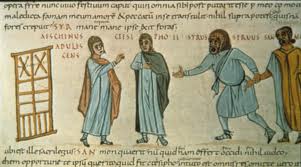
-
Syrus's twisting plot(s):
(1)
Bacchis brought with Antiphila to Chremes's house (why?)
(2) Syrus asserts he'll get money for Bacchis from Chremes (aside: "I must aim a trick at the old man ...", 512ff.), but Chremes tells him to trick Menedemus (536ff.), though Menedemus forewarned (470ff.)
(3) Syrus
improvs, tells Chremes that Antiphila is collateral for debt owed to Bacchis by Corinthian woman, can be ransomed for cash (599ff.); Chremes says Menedemus won't agree to buying her, but Syrus asserts this is no problem (610ff.) (?)
(4) discovery that Antiphila is Chremes's daughter (Sostrata & ring, 612ff.), so Menedemus can't buy her: Syrus boasts of new plan to tell the truth(!) and get money from Chremes (710ff.); moves Bacchis to Menedemus's house, Clinia tells Menedemus about Bacchis & Antiphila
(5) Syrus revives debt story (790ff.) to get Chremes to pay (daughter is collateral to Bacchis); Syrus talks Chremes into letting Clitipho take money to Bacchis (799ff.) = first money exchanged in play (at Chremes's expense!)
(6) Menedemus tells all to Chremes (847ff.), who is disbelieving (duped by Syrus into believing Clinia has convinced Menedemus that Bacchis is Clitipho's girlfriend & plans to marry Antiphila to extort wedding money from Menedemus); Chremes pretends to betroth Antiphila to Clinia, so Menedemus can be tricked
(7)
angry Chremes realizes deception & disowns Clitipho (must rely on Clinia's generosity, 965ff.); Syrus's final (successful?) improvised trick to reconcile father & son is false adoption story (to Clitipho)
-
play's resolution (873ff.): Menedemus understands all (Clinia sincere about marriage, has seen Clitipho with Bacchis)
Self-Tormentor 915-929 (Chremes realizes truth)
Chremes
You're right to laugh at me. It's myself I'm angry with now. Think of all the clues that they could have made me realize, If I wasn't a blockhead! Think
of what I saw! Oh, I'm shattered! But they certainly won't go unpunished, as sure as I'm alive! Now I'm going to—
Menedemus
Can't you
control yourself? Won't you spare a thought for yourself? Aren't I enough of a warning for you?
Chremes
I'm out of mind with anger, Menedemus!
Menedemus
Fancy you talking like that! Isn't it disgraceful for you to give
advice to others, and to be wise about what doesn't concern you, but to be unable to help yourself?
Chremes
What should I do?
Menedemus
What you said I'd failed to do: let him realize that you're his father; give him the courage to discuss everything with you,
to ask and request things from you, so that he doesn't look for a supply elsewhere and abandon you.
Chremes
No,
I'd much rather he went off anywhere in the world than that he stayed here to reduce his father to poverty by his disgraceful behaviour!
-
Chremes approves marriage for real, but disinherits son (939ff.) & exits
-
Syrus suggests to Clitipho he's adopted (unloved now biological sister reunited with parents)
-
Sostrata informs Chremes of Clitipho's fears; Clitipho appears & Chremes acknowledges him as his son (1033)
-
Chremes forces Clitipho to admit to bad behavior (Bacchis, deception); resolution with second marriage
-
Has Chremes learned from experience? Will Clitipho transform into responsible adult?
Practice Commentary, Examination #1:
(a) identify the playwright and play from which the passage is taken;
(b) identify the speaker(s) of the passage;
(c) briefly describe the context of the play in which the passage occurs;
(d) comment on the broader significance of the passage in light of the play’s themes, its characters, its comic or dramatic techniques, its social, historical or literary aspects, etc.
Speaker A
He’s gone and you’re all on your own, Pseudolus.
You laid it on thick for your young master and now
It’s time to bring home the bacon, wherever that is.
Let’s see: you haven’t got the least bit of a plan, just as
Much money, and no idea what to do at all either.
Where to start weaving your web of deceit,
Or how to bring that design to completion?
But just like a poet takes up his tablet and though
He looks for what doesn’t exist at all, he still finds it, and
Makes complete fiction seem like the truth.
That’s it! I’ll become a poet and find
The twenty minae which are nowhere.