Classics 351
April 21, 2022
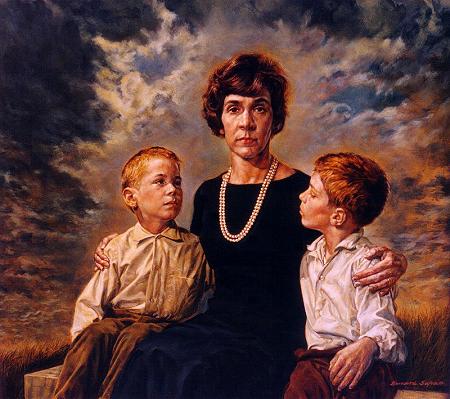

L: Bernard Safran, Medea, 1964: R: Maria Callas in Cherubini's Medea, Milan, 1953
Response #2: Due Tuesday, April 26 (11:59 pm in D2L)
Student Course Surveys: https://scs.arizona.edu/content/5
Seneca's Medea (cont.)
"40 maps that explain the Roman Empire" (Vox)
- Medea & Roman anxieties about empire: Corinthian/Roman Chorus's "Otherizes" Medea as The Barbarian, witch consolidating the toxic products of globalism (Nurse: "She is chanting and the world is shaking at her spell," 739)—a compelling reading of her character/the play?
Medea 366-372 (Act 2 Chorus, their nativist nostalgia)
Now there is no need of a ship made by Pallas' hand,
rowed by kings, a well-renowned vessel—an Argo.
Any old skiff can wander the deep.
All boundaries are gone and the cities
have set up their walls in new lands:
the world is a thoroughfare, nothing remains
where it was.
Medea 849ff. (Act 4 Chorus, fearing the wedding may become a funeral)
Where is this blood-stained Maenad rushing,
headlong, seized by barbarian lust ...
... Who would believe her an exile?
... Medea cannot understand restraint
for anger, or for love.
Now anger and love have joined
to give her a cause: what will happen?
When will this Colchian monster
leave the lands of Greece
and release
from fear
the kingdom and royal family?
- Act 4 (Nurse, Medea): conjuring the dark powers of earth, land & sky as superhuman figure of creativity/destruction ("Spirits ... hurry to this new wedding", 743); children sent to deliver wedding gifts (846ff.)
Act 5: messenger's speech interrupted ("daughter and father together lie mixed with ash", 880): (human) Medea assumes complete control of stage-spectacle (monologue, 893-977)
- Medea's divided self (tensions): mother/rejected lover, mortal/divinity, performer/person, etc.
Medea 903-912 (with the royal family now destroyed, Medea contemplates further violence)
… Whatever I did before,
Name it dutiful love. Come now! I will reveal
how trivial and ordinary they were,
those crimes I did before. With them my bitterness
was only practicing: how could my childish hands
do something truly great? Could the rage of a girl do this?
Now, I am Medea. My nature has grown with my suffering.
I am happy that I ripped my brother’s head away,
I am glad I sliced his limbs ...
[cf. "Go on, be daring, begin / to do whatever Medea can do, and even more than that", 566-567; "prove to the people the things you can do", 977]
- vengeance: balancing the books?
Medea 924-925 (murder of children as sacrificial compensation)
... Children—once my children—
you must give yourselves as payback for your father's crimes.
Medea 982-986 (just before killing first child)
Now, now I have regained my throne, my brother, and my father.
The Colchians keep the treasure of the Golden Ram.
My kingdom comes back to me,
my stolen virginity returns.
O gods, you favour me at last, O happy day,
O wedding day!
[cf. Medea's description of her dowry as her kingdom, father, and brother, 488-489]
Medea 967-971 (just before climbing roof and first murder)
Leave me, my brother, and you avenging goddesses,
and order your ghosts to go back to the depths of Hell.
Leave me to myself and use this hand, my
brother,
which has drawn this sword: we appease your spirit now,
with this sacrificial victim ...
- her growing conflict: self-awareness, regret, guilt, dissatisfaction (+ jealously/revenge; cf. Atreus)
Medea 919-921
... Fool! I went too fast.
I wish my enemy had some children
by that concubine of his.
Medea 932-939 (anger vs. love)
... Poor things! What crime have they ever done?
Jason is their father: that is their crime. And worse:
Medea is their mother. Let them die; they are not mine.
Let them die; they are mine. They did nothing wrong, they are blameless,
they are innocent: I admit it. So was my brother.
Why, my soul, do you waver? Why are my cheeks blotched with tears,
why am I led in two directions, now by anger,
now by love?
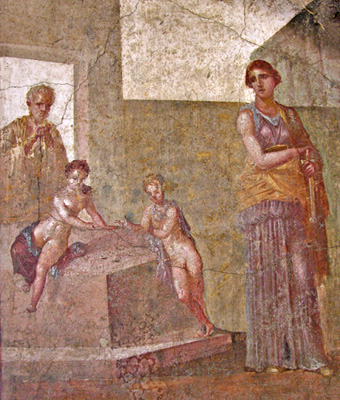
Medea Fresco, Casa di Dioscuri, Pompeii, 1st century CE
- Medea’s development from a virginal girl to a woman & woman to a virginal girl again (by un-marrying Jason)?
Medea 49ff.
I did those [crimes] as a girl. Let weightier rage swell up:
now I have given birth, my crimes ought to increase …
Medea 1010-1013 (just before killing second child)
... Although I shall kill two,
the number is too small to satisfy my pain.
If my womb even now contains any pledge of our love, I, the mother,
will scrape my insides with my sword, I will bring it out with the blade.
- necessary dehumanization of the children (implicated in crime against royal family): the arithmetic (complex calculus?) of revenge
Medea 954-957 (just before she sees the Furies and her brother's ghost)
I wish as many children as proud Niobe bore
had come from my womb, I wish I had
twice-seven sons! I was infertile for revenge:
but my two are just enough to pay for brother and father.
- relishing the painful spectacle after killing first child with Jason as internal audience
Medea 991-994 (cf. Euripides's Medea, where Jason appears after both children killed)
I have done it. Great pleasure steals over me against my will,
and see! now it grows. This was all I was missing,
that Jason should be watching. I think I have so far done nothing:
crimes committed without him were wasted.
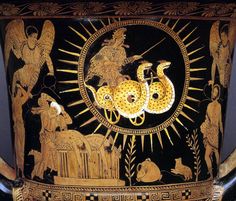
Medea's Dragon-Chariot, Lucanian red-figure krater, 4th century BCE
- Medea's final analysis of killing of children as sacrifice: "Rage, I had no more / to sacrifice to you" (1019-1020); show's over ("This is the way I always leave a country", 1022)
- grim, godless ending
Medea 1026-1027 (Jason's last angry words)
Go, travel on up high through the deep expanse of the heavens,
prove that there are no gods wherever you go.