CLAS 351
April 26, 2022

Detail of Polyxena Sarcophagus, 520-500 BCE (discovered in Turkey, 1994)
Response #2 is due tonight @ 11:59pm (in D2L Assignments)
Student Course Surveys: https://scs.arizona.edu/content/5
GROUP PROJECTS (Tuesday, May 3): 15 mins. presentation on a post-classical reception (plays, films, music, visual arts, etc.) of one of these tragic (Senecan) or "tragicomic" (Plautine) plays: Amphitryon, Captivi, Rudens, Thyestes, Phaedra, Medea, Trojan Women
examples:
direct receptions (explicit adaptations)
Thyestes: a revenge tragedy such as Shakespeare's Titus Andronicus or Hamlet
Amphitryon: Jean Giraudoux's Amphitryon 38
Phaedra: Sarah Kane's Phaedra's Love, Jules Dassin's Phaedra
Rudens: Shakespeare's The Tempest
Medea: films, e.g. Pasolini's Medea, A Dream of Passion; Stuart Hill's fantasy novel, Blade of Fire
indirect receptions (common themes, ideas, characters)
Medea: love & vengeance, monstrous anger, metatheater (awareness of self-performance), contradictions of "civilization"
Trojan Women: the captured city, trauma of war's non-combatants, vengeance vs. mercy, toxic masculinity
Thyestes: cannibalizing family dysfunction & fragmentation, autocracy, human bestiality, horror as spectacle
Phaedra: familial dysfunction and miscommunication
Captivi, Rudens: terrifying loss of identity
Amphitryon: ontologically confusing Doppelgänger
Seneca, Trojan Women
- Hecuba's opening: long (cyclical) view of history & power; the current situation & her role in all

UCSB production of Trojan Women, 2010
Trojan Women 1-7 (power's & empire's impermanence)
Do you believe in power? Do you rule a palace,
and are you not afraid of the fickle gods?
Are you naive enough to trust in happiness?
Then look at me, and at this city, Troy. Fortune
has never given greater proof that those who stand
proud have no sure footing. The pillar of mighty Asia,
the glorious work of the gods, has toppled and lies on the ground.
Trojan Women 18-27 (emotions among the Greeks: hatred, pity, empathy, humility, mercy, vengeance?)
But the winners want their booty; fire cannot stop them.
Burning Troy is torn apart: we cannot see the sky
for the waves of smoke. As if under a dense cloud
this black day is dirty with the ash of Troy.
We lost, but they are hungry still, and eye
our stubborn city, slow to fall. Now at last those brutes
forgive us for the last ten years. Even they feel horror
at this ravaged city, and though they see Troy conquered
they
cannot yet believe the victory possible. Looters are stealing
the treasures of Troy. The thousand ships cannot hold the plunder.
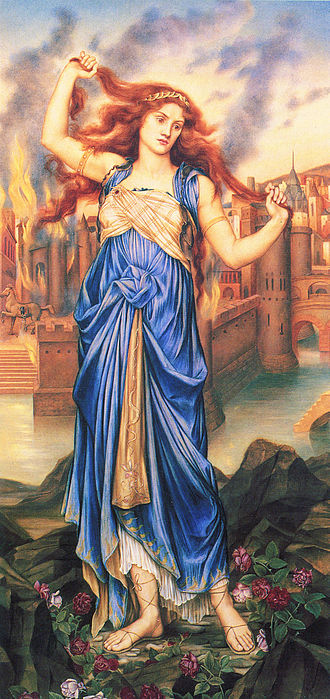
De Morgan, Cassandra Before
the Burning City of Troy, 1898
Trojan Women 28-42 (Hecuba's survivor's guilt & fresh traumas)
I call as witnesses my enemies—the gods,
and the ashes of my homeland, and my lord the king of Phrygia,
buried beneath your kingdom, covered by your city,
and you, the hero whose death marked Troy's fall,
and you great flocks of my dead children,
smaller ghosts: all this disaster,
all that from her crazed mouth Cassandra
predicted would go wrong—god banned belief—
I, Hecuba, foresaw when I was pregnant, and I spoke my fear,
before Cassandra I was the first to prophesy in vain.
It was not the cunning Ithacan hero and his friend
whose night raid set you alight. Nor was it Sinon's lies:
this fire is mine. O Troy, my marriage torch burnt you.
But why are you weeping for the ruins of a city destoyed?
Remember, poor old woman—ancient but alive—
more recent causes of grief: Troy's fall is old news.
- chorus's identity (Act 1: "You tell us to weep. We know well how to do it ...", 67; "Lucky Priam. This is happiness: / to die in war and take away, with loss of self, / all other losses", 161-163)?
- Act 2: Talthybius's supernatural report of Achilles's shade demanding Polyxena; prophet Calchas re Greeks' return home: "more blood is needed" (366), Astyanax must fall from Troy's highest tower
- a circumspect Agamemnon: bickering with Pyrrhus ("We have taken enough revenge, / and more than enough", 286-287)
Trojan Women 256ff. (Agamemnon rejects sacrifice, advises restraint)
First learn the crucial lesson:
there is an etiquette to victory, a limit to defeat.
Those who abuse their power never stay powerful long ...
... Victory itself
taught me how fast you can lose everything. Does Troy
make us proud or savage? No. We Greeks stand at the height
from which Troy fell. I admit, sometimes I was
tyrannical, too proud, out of control.
My pride is humbled by the very thing
which would have puffed up others: Fortune's smile.
Priam, you make me proud, but also frightened.
Can I believe that royal power is anything
but an empty, gilded name, hair fettered with false beauty?
- ancient audience's view of Agamemnon (his past? Cassandra, etc., in Aeschylus)?
- pitiless Pyrrhus: emphasizes Greeks' debt to Achilles, rights of conquerors ("No law protects prisoners of war. Punishing them is legal", 333); catalogues his father's conquests, genocide, sexual enslavement (210ff.); Agamememnon critiques slaughter of Priam in Aeneid 2 (311-314)

Andromache, Astyanax, and Hector in Troy, 2004
- traumatized Andromache (Act 3): since Achilles dragged "my body" (414) ... I am numb to suffering" (417); her vision of Hector warning about Astyanax, "If only the whole city had been flattened" (455)
- Andromache's choice of Hector's tomb as hiding place? ("patholology" of conjugal devotion & trauma?)
Trojan Women 503-510 (Andromache urges Astyanax on)
Son, go up to the tomb. Why are you pulling back?
You reject hiding as cowardly? I recognize your breeding;
you are ashamed to show fear. But now let go of your courage,
abandon your old pride and take what fortune gives.
Look at us, all the multitude surviving from the war :
a tomb, a boy, a female prisoner. We have to yield to disaster.
Come now, be bold enough to enter the sacred tomb
of your dead and buried father. If fate helps those in trouble,
you are safe; if fate refuses to let you live,
you have a tomb.
**GROUPS**