CLAS 355
Plautus's Captivi
February 2, 2023
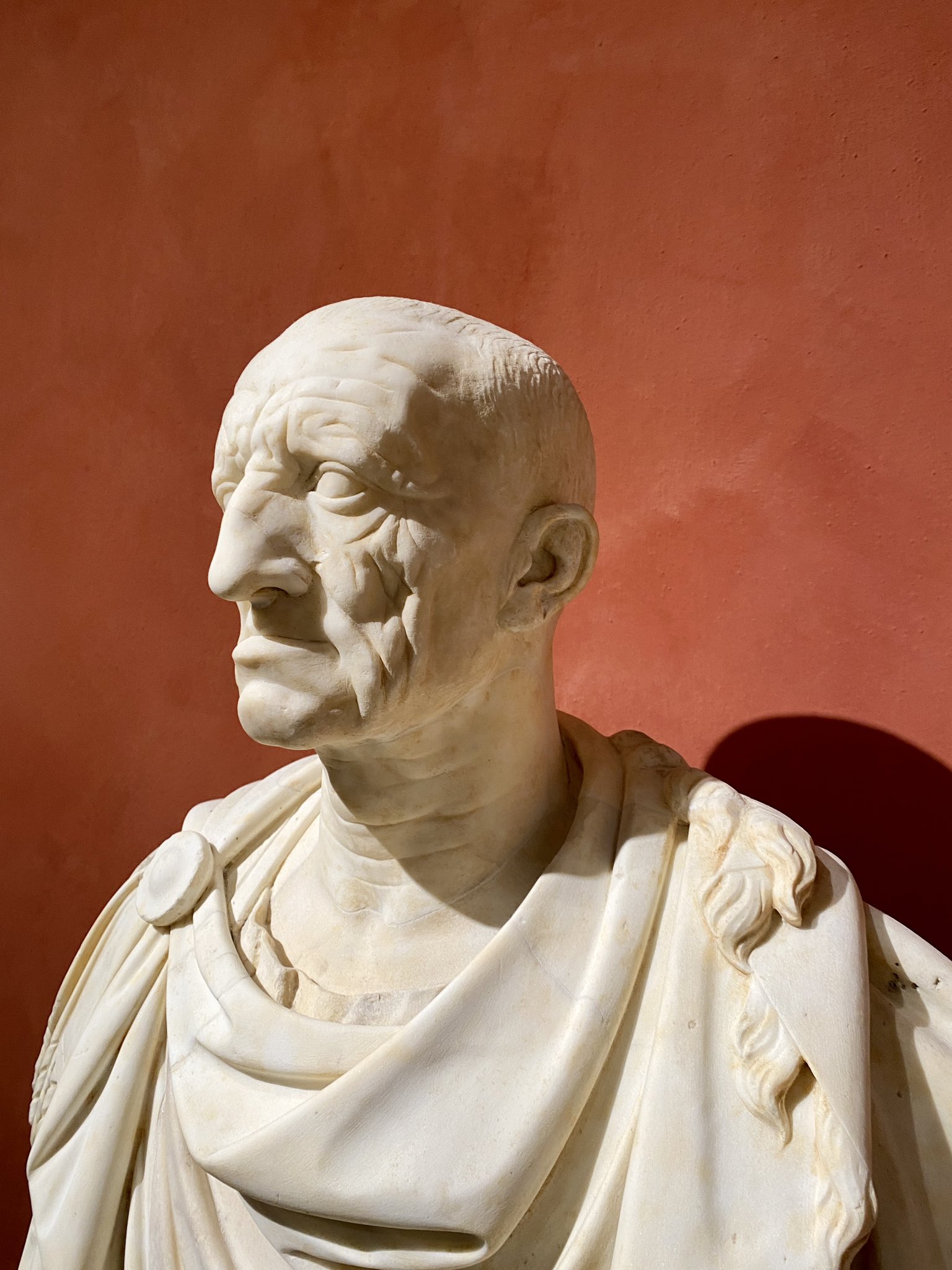

L: Roman Patrician, Otricoli (75-50 BCE); R: Robert DeNiro in Dirty Grandpa (2016)
**Study Guide for Examination #1 (Thursday, February 9)**
Plautus's Casina (cont.)
- Cleostrata's scheme: (temporarily?) inverting the power dynamic in marriage; the play-within-the-play?
Casina 815-24
(Pardalisca's mock-wedding song/advice to Chalinus the "bride")
Gently lift your feet above the threshold, my new bride;
Safely start this journey,
And tread upon your husband always!
May all power preside in you to crush and defeat him,
Your voice, your command perched high to beat him!
His job is to fill your closets, yours to empty his pockets!
Strive to deceive him, both night and day!
- sexual violence against Casina averted; Cleostrata's metatheatrical victory over Lysidamus (Myrrhina, with Pardalisca & Cleostrata, waiting for Lysidamus and Olympio to enter, "No playwright has ever devised a better / Plot than this clever production of ours!", 860-1)
- "slavish" Lysidamus forced to admit guilt (997) and pledge no future "lust after Casina" at risk of whipping (1000-3)
Casina 947-59 (Lysidamus, post-honeymoon violence)
It’s best to face my wife,
To go inside the house
And offer her my hide for punishment!
Anyone of you care to fill in for me there?
There’s no hope for my shoulders inside of that house.
Apart from playing the bad slave and hitting the road,
I’m fresh out of ideas.
Think that’s all nonsense?
Truth of it is, I’ll be beaten:
I may deserve it but that doesn’t mean I like it!
I think I’ll just take off this way—
Casina, 1005-6 (Cleostrata's decision to forgive Lysidamus)
But the only reason I'm going to forgive him
Is that this play is long and I don't want to make it any longer.
- lasting change in marriage or return to status quo (Lysidamus gets his walking stick & cloak back)? marriage & slavery?
Epilogue (Casina discovered to be free, marriage with Euthynicus)
Now the
right thing for you to do is to give us the thundering applause
We so richly deserve. Those who do will win the whore of their dreams
(and the wife will be none the wiser). Those who don't applaud as loudly as possible
Will take a he-goat bathed in sewer-water to bed instead.
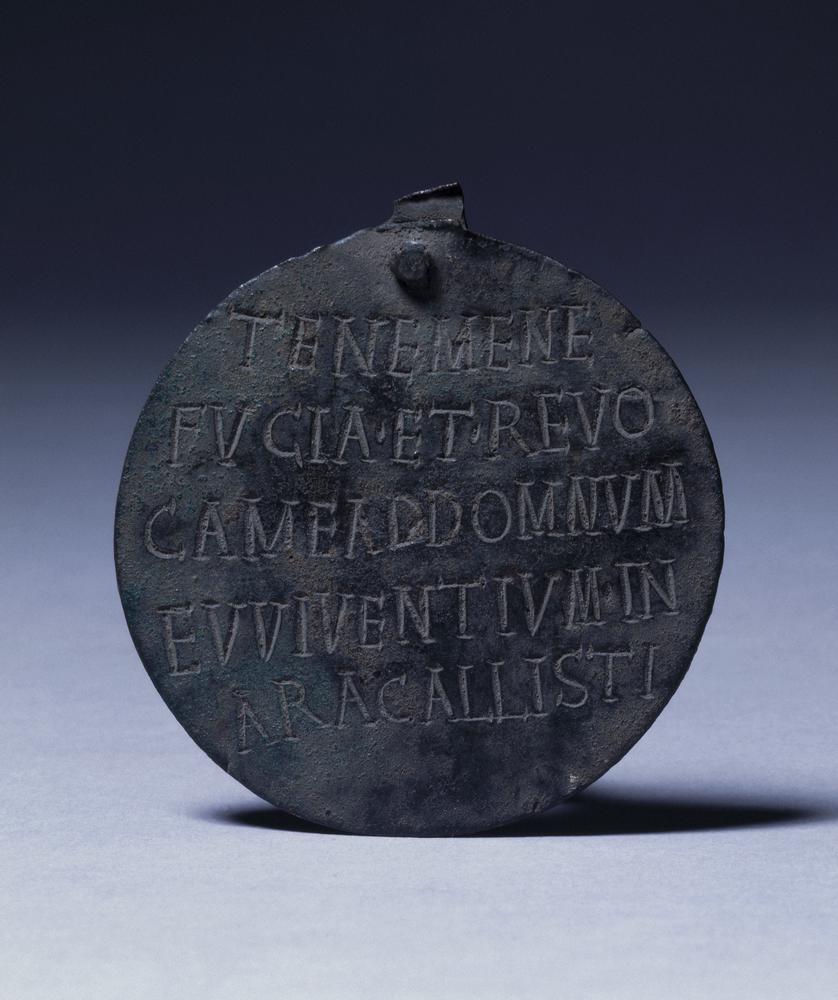
Roman Slave Collar ("Hold me, lest I flee and return me to my master"
)
Plautus's Captivi (ca. 190 BCE)
-
challenges popular ideology of slave ownership (slaves naturally inferior in character, intellect, morality, appearance, etc.); highlights the contradictions of human slavery (cf. Varro's description of slave as instrumentum vocale, “a tool with a voice”)
- a comedy about the arbitrariness of slavery (“We are the gods’ volleyballs!”, 22); the role of chance in determining status (& social performance?)
The unusual opening spectacle & prologue of Captivi:
(1) hierarchical seating in theater (1-16)
(2) plot background & current situation (chained prisoners' plot?)
(3) further complication re Tyndarus (49-51); parenting & slavery?
This one will stay here as his father’s slave,
Though he has no idea his master is also his own father.
When you think about it, we mortals are wretched fools!
(4)
the actors' social position (52)
What follows here is fact for us actors, even if it’s fiction for all of you.
(5) the unusually serious play (53-66)
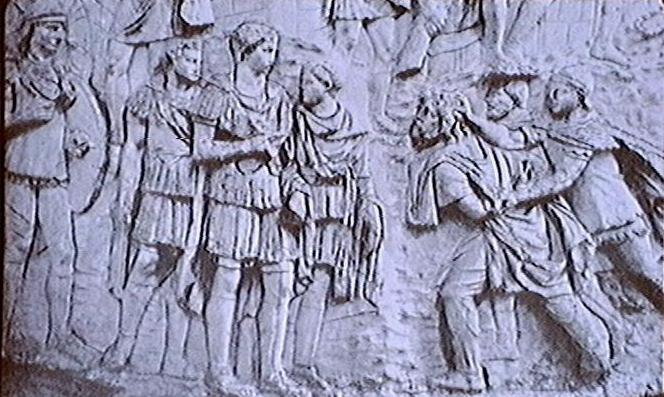
Captured Prisoner on Column of Trajan, 113 CE
GROUPS
Captivi: some select points:
- Tyndarus plays the "noble" master; benevolent mastery & ethics of reciprocity/"Golden Rule"
Captivi 297-316
Tyndarus
He was just doing his duty
When he gave it to you straight—though I was trying
To keep you in the dark about my wealth and family, Hegio.
Now that I’ve lost my country and liberty
I can understand why he’d fear you more than me.
An enemy assault has made him and me equals.
I can remember when he didn’t dare say a word against me; now he has
The freedom to do as he wants. Fortune lifts and lowers us as she pleases:
I once was a free man—and she’s brought me down from the top to the bottom;
I’d grown accustomed to giving orders and now I must take them.
I can only hope to find a master just like I was,
One from whom I can expect fair and gentle treatment.
If you don’t mind, Hegio, I’d like to offer you one piece of advice.
Hegio
Go ahead.
Tyndarus
I once was just as free as your son.
His freedom and mine were both taken away by an enemy attack.
He is now a slave in my country, just as I am in your house.
Surely a god is watching and listening to what we do, and will see
That his treatment there matches your treatment of me here.
Treat me well and he’ll treat your son well—and vice-versa.
My father misses me just as much as you miss your son.
- Tyndarus: the paradox of “the noble slave”
Captivi 682-688 (Tyndarus to Hegio after restraints are brought by Boxer, Killer, Banger)
I’m not afraid of dying, as long as it’s not for an unjust cause.
If he does not return and I die here, at least
What I did will be remembered after my death,
How I restored my master to his freedom, father, and fatherland
After he had been captured and enslaved by the enemy,
And how, to save his life, I choose to expose
Myself to the ultimate danger.
- character of Stalagmus; tense confrontation with Hegio (Scenes 15-16):
a deracinated slave from Sicily (887)
Stalagmus's opening response to Hegio ("my charming little piece of property", 954: “I used to be handsome and charming, but I've never been a 'good man'”, 956)
Hegio: “Hard to believe he was so respectful [morigerus, “obliging”, “compliant”, i.e., as a subordinate to a superior] as a boy” (967)
cf. Tyndarus's original name Paegnium (“Plaything”, 984); Philocrates: “I can assure you he had a proper and respectable upbringing” (992); cf. Ergasilus's pederasty joke to Hegio (Hegio: “I'm easy.” Ergasilus: “Old habit from when you were a boy, huh?”, 867)
Stalagmus's harsh economic perspective: “Hegio: Is he [Paegnium/Tyndarus] still alive?” Stalagmus: “I got my money. The rest I don't care about” (989)
final transfer of chains (Tyndarus > Stalagmaus) & the play's last word: “Just the thing for someone who has nothing of his own” (1022)