Horror, Terror, Violence & Trauma in the Ancient Roman World
Spring 2023
TTh 12:30-1:45pm
CHVEZ 301
SYLLABUS*
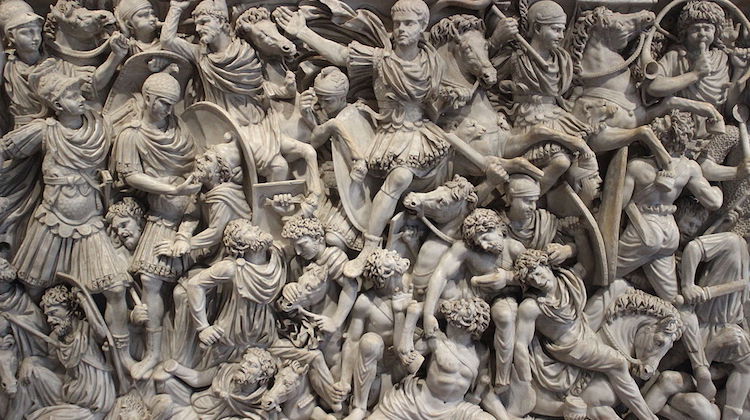
Course Description
This course examines some of the most culturally prevalent forms of horror, terror, violence, and trauma in the ancient Roman world. Our focus is traumatizing events – e.g. (civil) war, social and familial dysfunction, autocracy – as these are represented primarily in Roman literature (especially epic poetry, drama, biography, and the novel). We study two extremely violent institutions, Roman slavery and the spectacles of the amphitheater, for which extensive documentary and material evidence survives in addition to relevant literature. We will also consider modern materials, such as those related to the world wars of the twentieth-century, American slavery and the US Civil War, and contemporary catastrophes, as these provide comparative frameworks for interpreting how individuals and groups in the Roman world experienced and remediated suffering in their lives. CLAS 355 is a General Education Tier 2 Humanities course.
Instructor
Professor David Christenson (faculty webpage)
Modern Languages Building 326
621-5326; christed@email.arizona.edu
Office Hours: M 2:00-3:00pm, F 10:30-12:00pm, or by appointment
Course Objectives
Expected Student Outcomes
Class Participation
You are expected to prepare and complete all assignments in a timely manner, attend each class, bring relevant required text(s) to class, and to engage in creative discussion. The literary works and historical evidence that we are examining demand live discussion and fresh reinterpretation; please do not regard yourselves as passive consumers of them, or worse, as consumers of “information” about them to be dispensed by me in class. Historical and literary materials provoke and compel us to address important questions about human experience, none of which can be reduced to packaged “information.”
Attendance Policy
Participating in the course is vital to the learning process, and attendance is required. Students who miss class due to illness or emergency may present documentation from their health-care provider or other relevant, professional third parties.
Classroom Behavior Policy
In class, please always be respectful of others and practice common courtesy: turn off phones and other digital devices not necesary for class, please do not come to class late or leave early, or view materials unrelated to the course in class. Students using non-course related electronic media during class will be counted as absent.
Threatening Behavior Policy
The UA’s Threatening Behavior by Students Policy prohibits threats of physical harm to any member of the University community, including to oneself: http://policy.arizona.edu/education-and-student-affairs/threatening-behavior-students.
Course Requirements
1. Attendance and participation are expected.
2. There will be two examinations.
3. Quizzes (i.e. unannounced, on course readings) will be given on a regular basis (ca. 15 total).
4. Two written responses are required (2-3 pages each; I'll supply topics).
5. You are required to participate in a group presentation to the class.
6. A creative project is required.
7. There will be a final examination.
N.B.: There will be no make-up quizzes or examinations, or extra-credit assignments; the final examination cannot be taken early; responses must be submitted on the due date (those submitted after the due date will be penalized); a guide to writing responses will be posted on the course website and D2L.
Course Grade
1. 10% = attendance and class participation
2. 30% = two examinations
3. 15% = quizzes (ca. fifteen)
4. 20% = two written responses
5. 5% = group project/presentation
6. 5% = creative project
7. 15% = final examination
Scale:
A = 90-100%
B = 80-89 %
C = 70-79%
D = 60-69%
E = 59% and below
[grades will be posted on the course’s D2L site]
Writing Requirement
All General Education Courses are writing intensive. The requirement of a minimum of 10 pages/2,500 words will be met through short answers and essays on the three course exams, the two written responses, and through regular in-class quizzes. You will be asked to submit a draft of one of your responses, and after receiving feedback from me, you may submit a final, revised version for grading.
Honors Credit
The course is available for honors credit on an individual, contractual basis. Honors students, in addition to completing the requirements for all enrolled students, typically write a research paper (12-15 pages) on a focused topic requiring extensive reading and synthesis of secondary sources, as negotiated in consultation with me. I will meet individually with Honors students to formulate, outline, develop, and discuss this project.
Required Texts (various required readings are posted on D2L as PDFs)
Joshel, S.R. 2010. Slavery in the Roman World. Cambridge.
Walters, B. 2015. Lucan: Civil War. Indianapolis. [available at reduced cost through the Inclusive Access Program (D2L "Content") or as a limited access electronic resource (D2L “Library Tools”)]
Mahoney, A. 2001. Roman Sports and Spectacles: A Sourcebook. Indianapolis [available at reduced cost through the Inclusive Access Program (D2L "Content")]
Wilson, E. 2010. Seneca: Six Tragedies. Oxford. [available as an electronic resource (D2L “Library Tools”)]
Ruden, S. 2011. Apuleius: The Golden Ass. New Haven. [available as an electronic resource (D2L “Library Tools”)]
(hard copies of the required texts are available through the UA Bookstore)
Accessibility and Accommodations
At the University of Arizona we strive to make learning experiences as accessible as possible. If you anticipate or experience barriers based on disability or pregnancy, please contact Disability Resources (520-621-3268, http://drc.arizona.edu) to establish reasonable accommodations.
Please be aware that the accessible table and chairs in this room should remain available for students who find that standard classroom seating is not usable.
UA Nondiscrimination and Anti-harassment Policy
The University of Arizona is committed to creating and maintaining an environment free of discrimination. In support of this commitment, the University prohibits discrimination, including harassment and retaliation, based on a protected classification, including race, color, religion, sex, national origin, age, disability, veteran status, sexual orientation, gender identity, or genetic information. The University encourages anyone who believes he or she has been the subject of discrimination to report the matter immediately as described in the section below, “Reporting Discrimination, Harassment, or Retaliation.” All members of the University community are responsible for participating in creating a campus environment free from all forms of prohibited discrimination and for cooperating with University officials who investigate allegations of policy violations. See further: http://policy.arizona.edu/human-resources/nondiscrimination-and-anti-harassment-policy
UA Code of Academic Integrity
Each of you must adhere to the University of Arizona’s Code of Academic Integrity: https://deanofstudents.arizona.edu/policies/code-academic-integrity. You are encouraged to share intellectual views and discuss freely the principles and applications of course materials, but graded work/exercises must be the product of independent effort unless otherwise instructed. The University Libraries offers advice on avoiding plagiarism: http://new.library.arizona.edu/research/citing/plagiarism
Content Warning
Our course materials treat topics such as violence, sexual assault, slavery, and torture that may pose personal challenges. Please be assured that these issues will always be treated with the utmost sensitivity and professionalism, and that their inclusion in the course is intended to generate productive and valuable discussion. Please speak with me in advance to discuss any content related concerns, as alternative materials may be available.
The Classics Major and Minor
The University of Arizona’s interdisciplinary Department of Religious Studies and Classics offers a major (B.A.) and a minor in Classics, with options in Classical Civilization, Greek, or Latin. For more information on the Classics major and minor, see http://classics.arizona.edu.
Classics majors have pursued careers in a wide variety of fields, including business, government, law, medicine, education, and social services. Many students have paired the Classics major with majors in a wide range of fields, earning a double major or dual degree. This provides a comprehensive undergraduate education and gives graduates a competitive edge when applying for jobs or graduate studies.
For questions about the Classics major or minors and/or to declare a major/minor, contact the Classics undergraduate faculty advisor, Dr. Robert Stephan, at classics-advising@email.arizona.edu or visit https://classics.arizona.edu/declare. You also can contact the College of Humanities Advising Office for any advising needs, at http://advising.humanities.arizona.edu.
The Department also offers a major (B.A.) and a minor in Religious Studies, as well as a minor in New Testament Language and Literature. For more information on these degree options, see religion.arizona.edu and religion.arizona.edu/students/new-testament.
*The information contained in this syllabus, other than the grade and absence policies, may be subject to change with reasonable advance notice, as deemed appropriate by the instructor.