CLAS 355
Lucan's Civil War
February 14, 2023

Royer, Vercingetorix Throws Down his Arms at the Feet of Caesar, 1899
Exam #1 Key
*Response #1: due Friday, February 24 (11:59pm)*
Creative Project (due April 25)
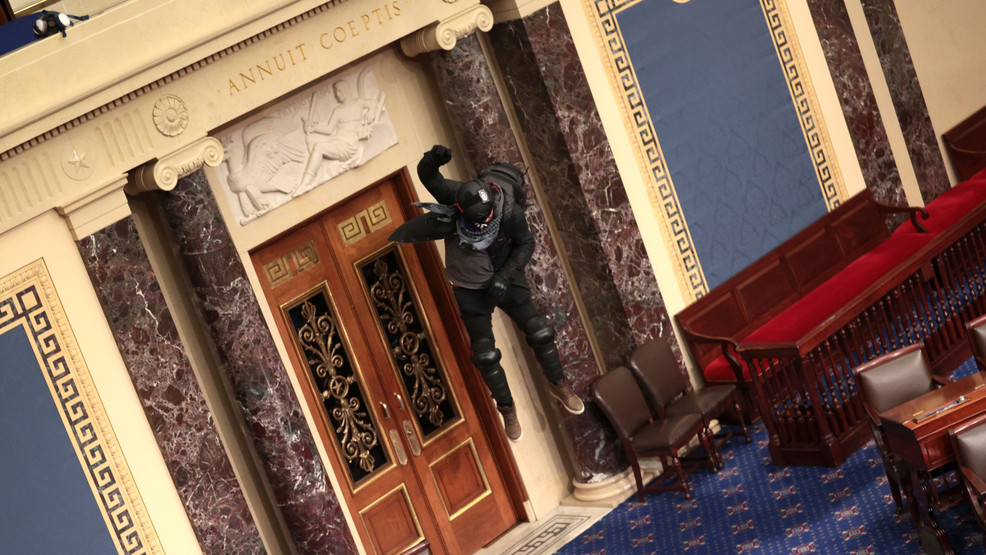
Insurrectionist in US Senate Chamber, January 6, 2021 (ANNUIT COEPTIS)
8 US Senators and 139 Members of Congress voting to overturn 2020 presidential election: https://www.nytimes.com/interactive/2021/01/07/us/elections/electoral-college-biden-objectors.html
Recent "seditious conspiracy" convictions: https://www.washingtonpost.com/dc-md-va/2023/01/23/oathkeepers-verdict-seditious-conspiracy-jan6-guilty/
Lucan, Civil War: Walters's translation (synopses of books, pp. xxxviii-xlviii; Glossary of Names, etc., pp. 239ff.)
- Marcus Annaeus Lucanus ("Lucan"): born in Cordoba, Spain (39 CE), wealthy & well-connected literary family; educated in Rome; court of Nero (emperor 54-68 CE); nephew of Seneca
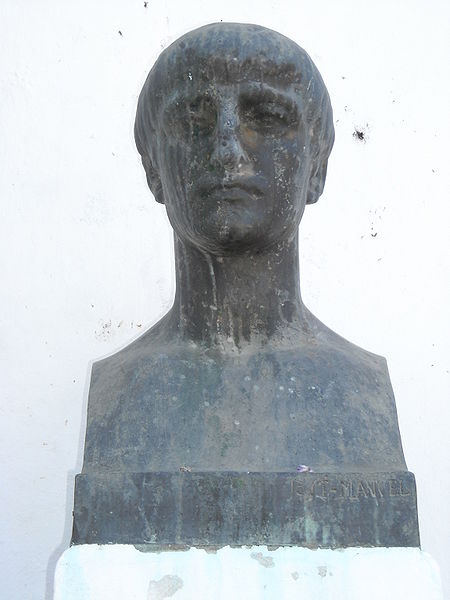
Bust of Lucan (public square, Córdoba)
- Lucan's unfinished Civil War aka Pharsalia; strained relations with Nero; Pisonian conspiracy of 65 CE; forced suicide (April 15, 65 CE) after brief & brilliant poetic career
Tacitus, Annals 15.70
Nero next ordered the despatch of Lucan. When his blood was flowing, and he felt his feet and hands chilling and the life receding little by little from the extremities, his heart still retained warmth and sentience. Lucan recalled a passage in his own poem, where he had described a wounded soldier dying a similar form of death, and he recited the very verses.
- tradition of Roman historical epic poetry: Julius Caesar (100-44 BCE) vs. Pompey the Great ("Magnus", 106-48 BCE) + co-opted armies; 49-45 BCE phase of civil wars that end Roman Republic & Roman experiment in constitutional quasi-democracy (oligarchy) > Roman imperial government/principate (Octavian = Caesar Augustus in 27 BCE), Nero last of Julio-Claudian dynasts
- Lucan's Civil War: fictionalized historical memory of events 100+ years before Lucan; Civil War hostile toward Caesar(ism) = destruction of Roman Republic/loss of libertas/Rome's enslavement; Lucan's nostalgia for Roman Republic (pro-senatorial elite lamenting lost oligarchy)
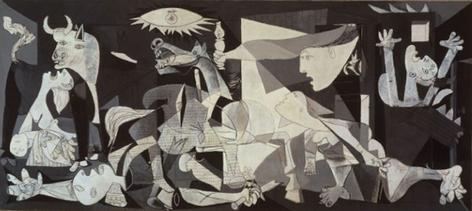
Picasso, Guernica, 1937
- Lucan's central theme: fragmentation of body politic & society > cultural trauma/catastrophe (as constructed by Lucan)
Civil War 1.1-9 (Lucan's programmatic opening)
Wars—we sing—worse than civil and waged
Across
Thessalian plains, crimes masquerading as law,
A powerful state disemboweling itself with its own
Victorious right hand, fathers fighting against sons,
And when the tyrannical compact was shattered ["first triumvirate"; death of Crassus at hands of Parthians in 53 BCE]
All the strength of the shaken world clashed in battle
That stained us with guilt forever—with standards
Pitched on hated
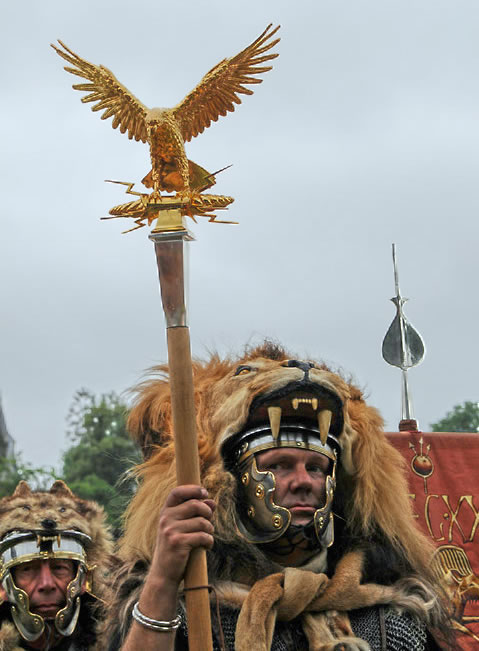
standards, Eagles matched,
Javelins threatening javelins on either side.
Civil War 1.29-39 (the poet's apocalyptic vision of civil war's effects)
Now in Italy's cities the walls have crumbled,
The buildings slump half-ruined, their ramparts
Everywhere large piles of stone. The houses stand
Unguarded and the ancient city-streets are empty of all
But the rare inhabitant, wandering in his ghost town.
Now Italy's countryside lies overgrown with brambles,
Her fields unplowed for many years. No hands remain
For the work she demands. You didn't achieve this,
Fierce Pyrrhus, nor did savage Hannibal cause such pain.
No—foreign swords could never pierce so deeply.
The deadliest wounds are dealt by citizen hands.
Civil War 2.24-33 (simile describing general shock in Rome)
It's the same in a household shocked silent
By sudden death—before the body is laid out
And lamented, before the mother unbinds her hair
And bids the slave girls beat their breasts,
She grasps its limbs, stiff and lifeless,
Embraces its bloodless face and closes its eyes
Now menacing in death. She isn't sad yet,
But isn't afraid anymore either—so just hovers
Over the corpse, marveling at her misfortune.
Glory (1989): 54th Massachusetts Infantry Regiment formed after Emancipation Proclamation of 1863; Battle of James Island: https://www.youtube.com/watch?v=kbMH2mu_PhI
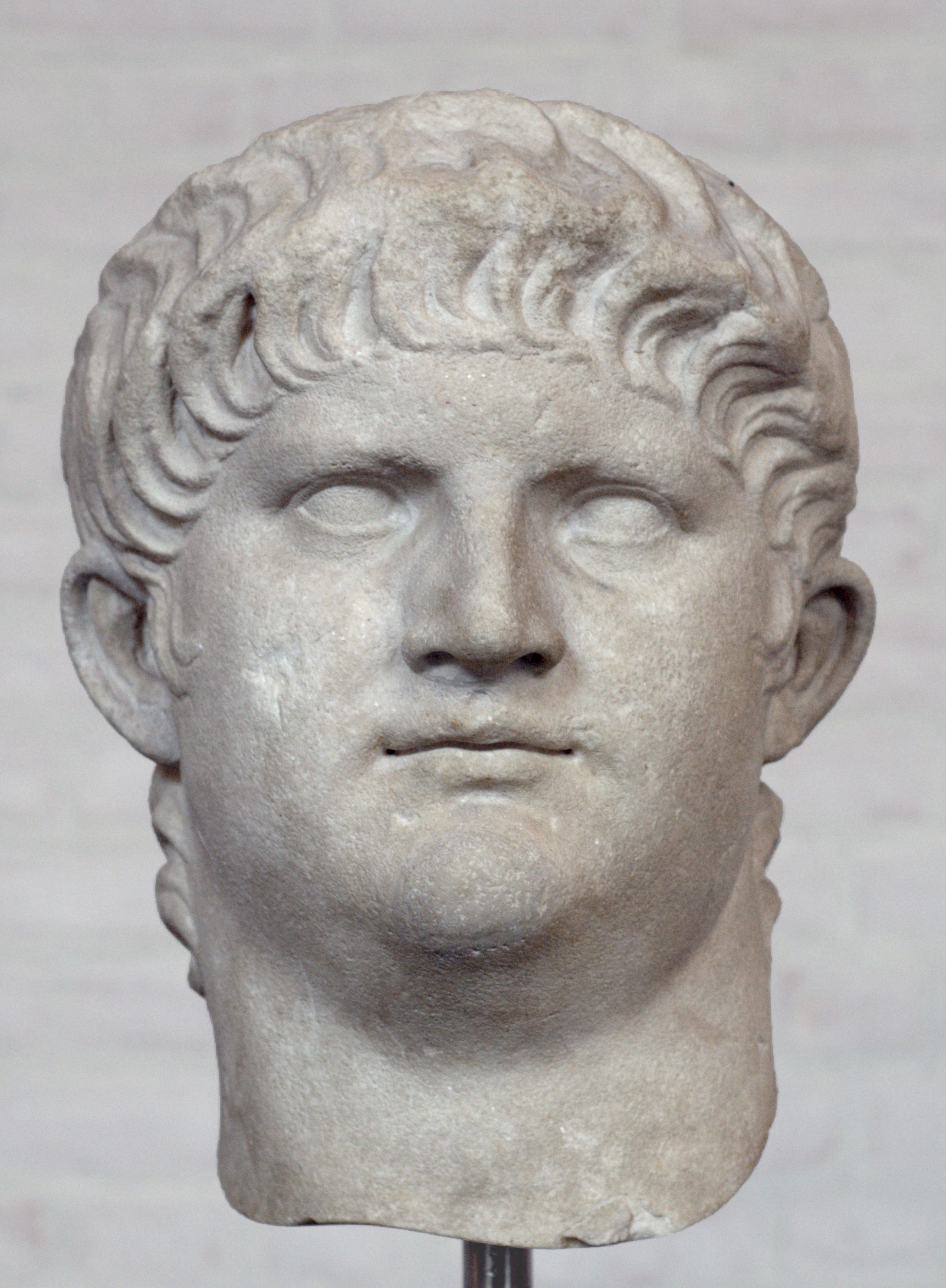
Head of Nero, ca. 65 CE
- flattering Nero: opening panegyric of the emperor as compensation for civil carnage
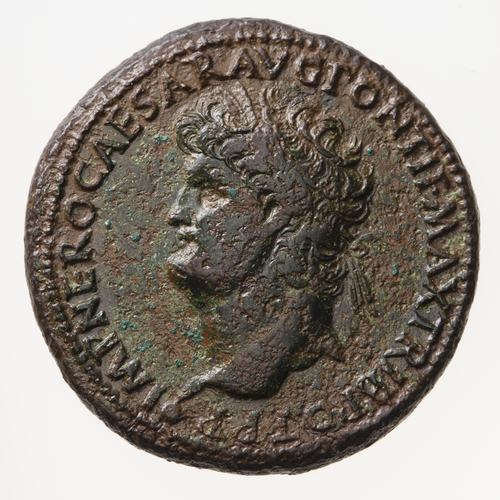
Sesterius depicting Nero, ca. 66 CE
Civil War 1.50ff.
. . . Rome owes much to civil war,
Caesar, since everything done was for you.
And when your time on earth is over, when at last
You seek the stars, heaven will be glad to have you.
Claim whatever seat you want . . . [Nero's apotheosis]
. . . Just don't set your throne in the Arctic North
or
where the sweltering hinge turns Southern skies:
Your star's vision of Rome will be slanted there.
And if you place your weight down hard on either side
Of the unbound aether, heaven might fold beneath the burden. [Nero's gravitas]
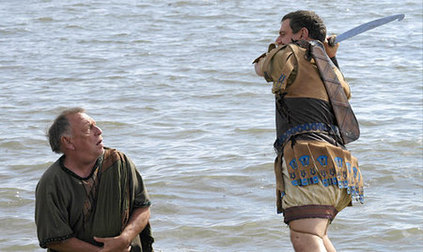
Rome (HBO series, 2005-7)
one of Caesar's soldiers gets "out of line" in Gaul: https://www.youtube.com/watch?v=-vJTNGH4Ib0
the Roman Senate debates on Caesar's status and ambitions: https://www.youtube.com/watch?v=K9ahNR19myM
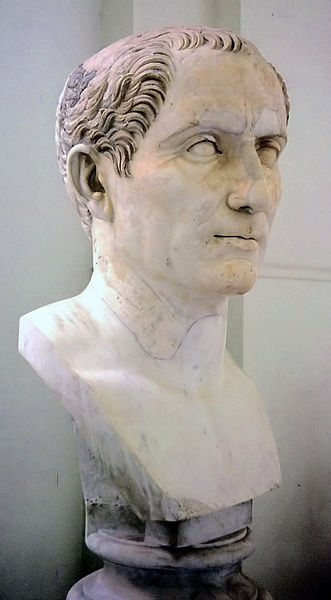

L: Julius Caesar, 1st century BCE; R: Bust of Pompey, 52-51 BCE
- Lucan's principal characters: Julius Caesar & Pompey the Great/"Magnus" ("Caesar can't brook a superior any more than / Pompey can handle an equal", 1.141-2); paired similes

Civil War 1.154-162 (Pompey "a shadow of his 'Great' name")
He stands, like a towering oak in fertile fields
On which old spoils are hung and the dedications
Of long-dead generals. Its roots rotted to nothing
Long ago, only its size now holds it in place,
And though its bare branches spread across the sky,
Its trunk alone casts a shadow, there are no leaves.
Though it totters and almost falls with every breeze,
And many younger trees stand strong all around,
It alone is worshipped.
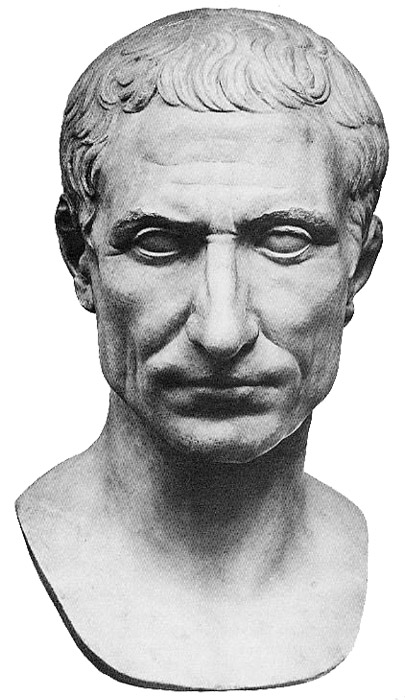
Bust of Julius Caesar, ca. 45 BCE
Civil War 1.169-175 (the violently ambitious Julius Caesar)
Trampling everything in his way, he rejoices in ruin
Like a lightning-bolt driven by winds through the clouds
Sparks with loud thunder and shatters the heavens
Into daylight. It terrifies the frightened people
And dazzles their eyes with its jagged flame.
It rages
in its precincts, unstoppable, wreaking havoc
Far and wide and gathering its scattered fires.
- Caesar's army: cult of personal loyalty depicted in speech of Laelius the Centurion
Civil War 1.413-428 (after Caesar's speech leaves soldiers hesitant to march on Rome)
“We're willing and able to follow your every command.
And no one's a fellow citizen of ours, Caesar,
If your war-trumpet sounds against him.
By your standards, fortunate now for ten years,
And by your triumphs over every enemy, I swear:
If you order me to stab my brother in the heart,
Or slit my father's throat, or plunge a sword in the gut
Of my pregnant wife, I'll do it, even if unwilling.
If you order me to rob the gods and raze their temples,
Their statues will melt over the flames of this army's mint.
If you order me to set up camp on the Tiber's waters,
I'll trample Italy's fields boldly and lay the lines.
Whatever walls you want smashed to the ground,
These arms will drive the ram and scatter the stones,
Utterly tearing down whatever city you order—
Even if it's Rome.”
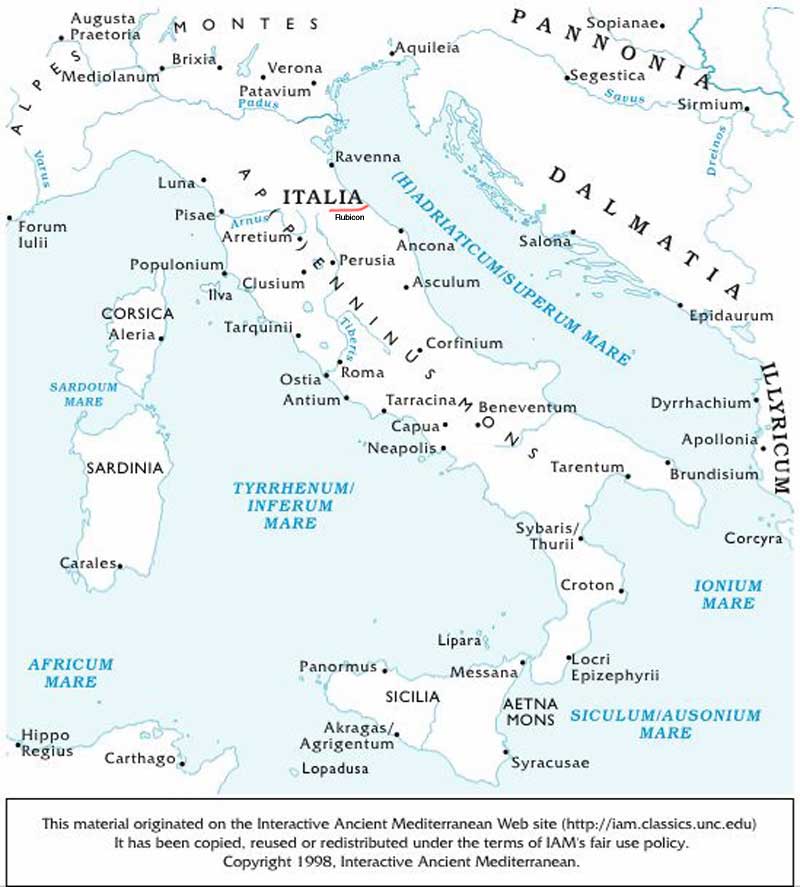
- Rubicon (Gaul/Italy) crossed in January, 49 BCE (Roma: "To what destruction are you rushing . . .?, 1.213); catalogue of Caesar’s allies (1.434ff.) + joy of Rome's enemies; rumors & panic in Rome (1.563ff.)
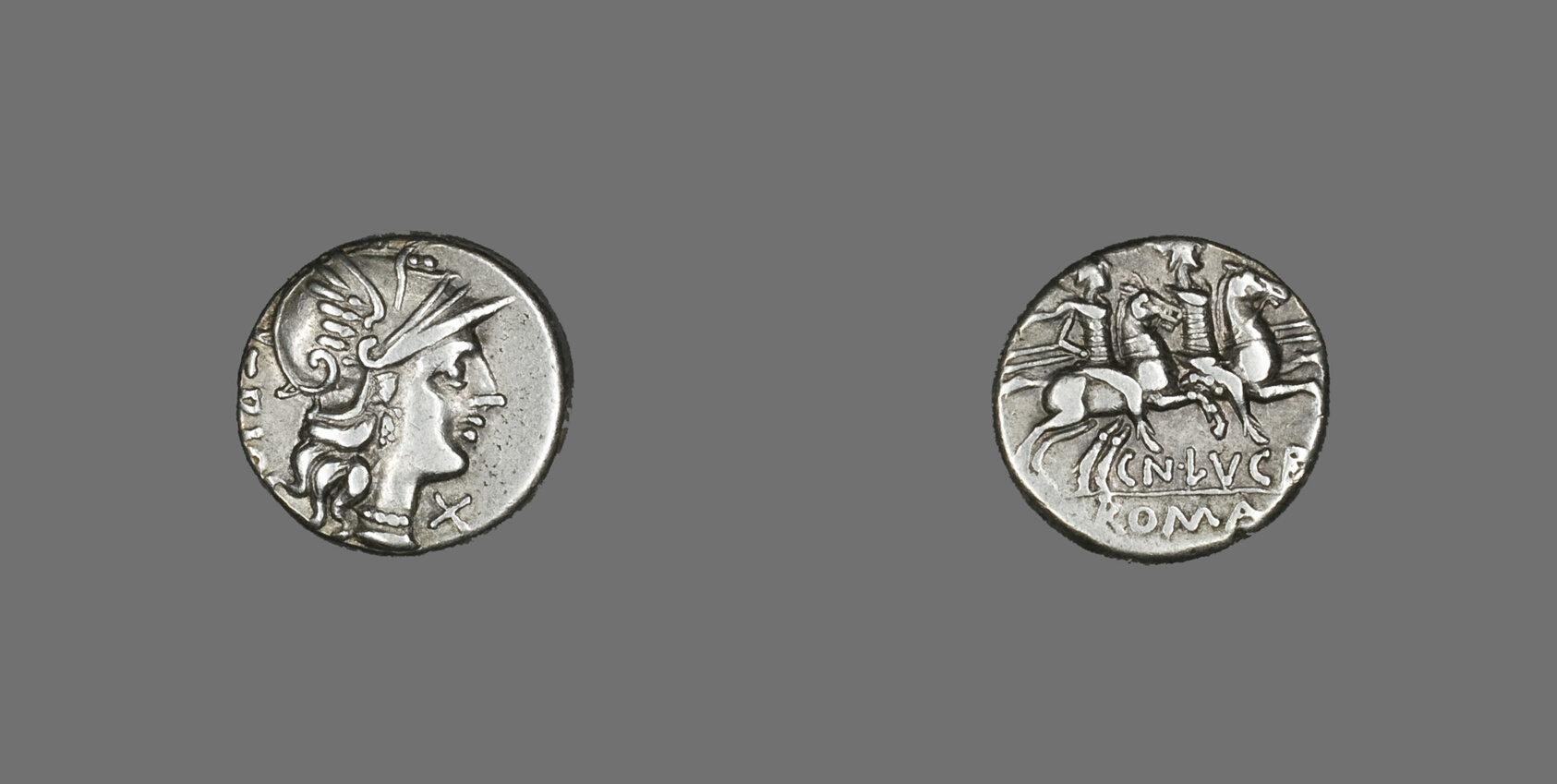
L: Roma, silver denarius (136 BCE)
- Close of Civil War 1 (Caesar approaches Rome): Arruns the soothsayer's grotesque sacrifice & entrail-reading (entispicia, 1.648ff.); prophecies of anonymous matron in terrorized Rome ("Wait! Wait!—Him I recognize, / That headless corpse sprawling across wet sands," 1.735-6)
Civil War 1.713-721 (Figulus the astrologer forecasts bleak Roman future)
“War's fury is upon us: and the power of arms
Will overturn every law by force, virtue
Will be redefined as unspeakable crime,
And this madness will carry on for years and years.
And what's the point in begging gods to stop it?
When peace comes, she'll make slaves of us all!
Prolong the endless chains
of evils, Rome,
Draw out the destruction as long as you can—
You're only free now while civil war still rages!”
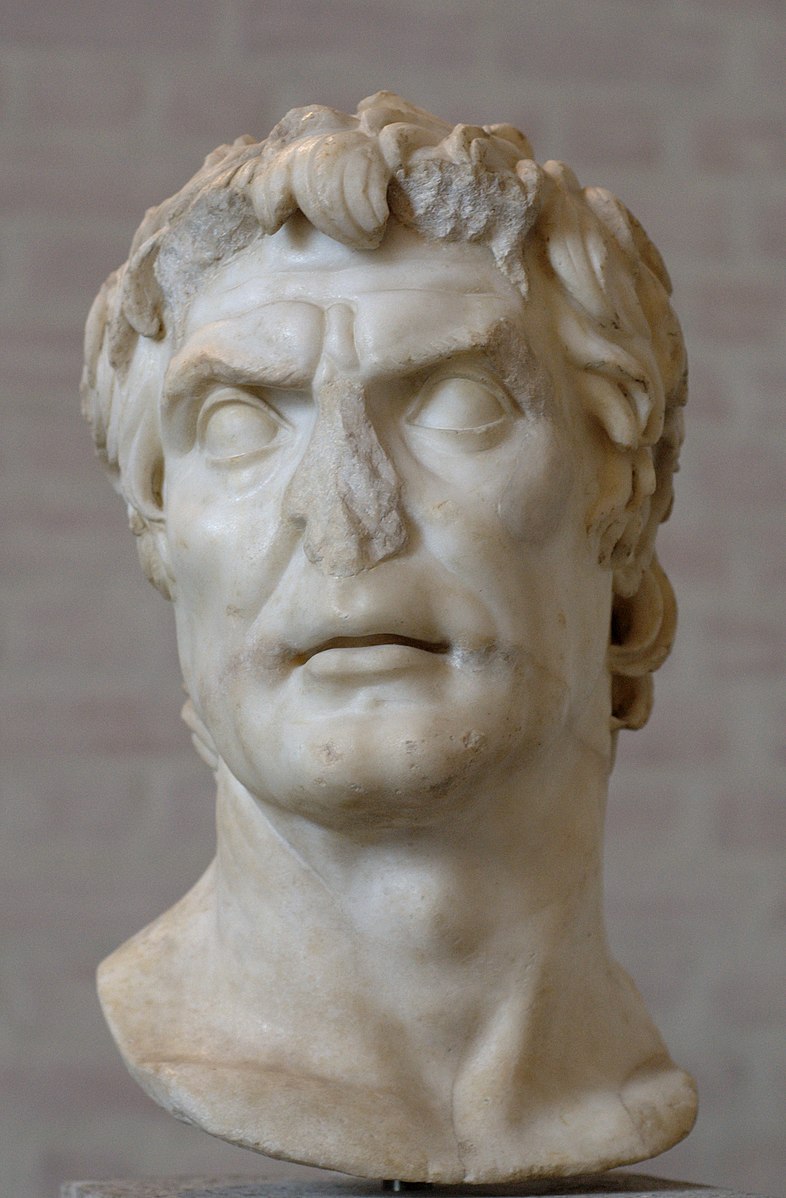
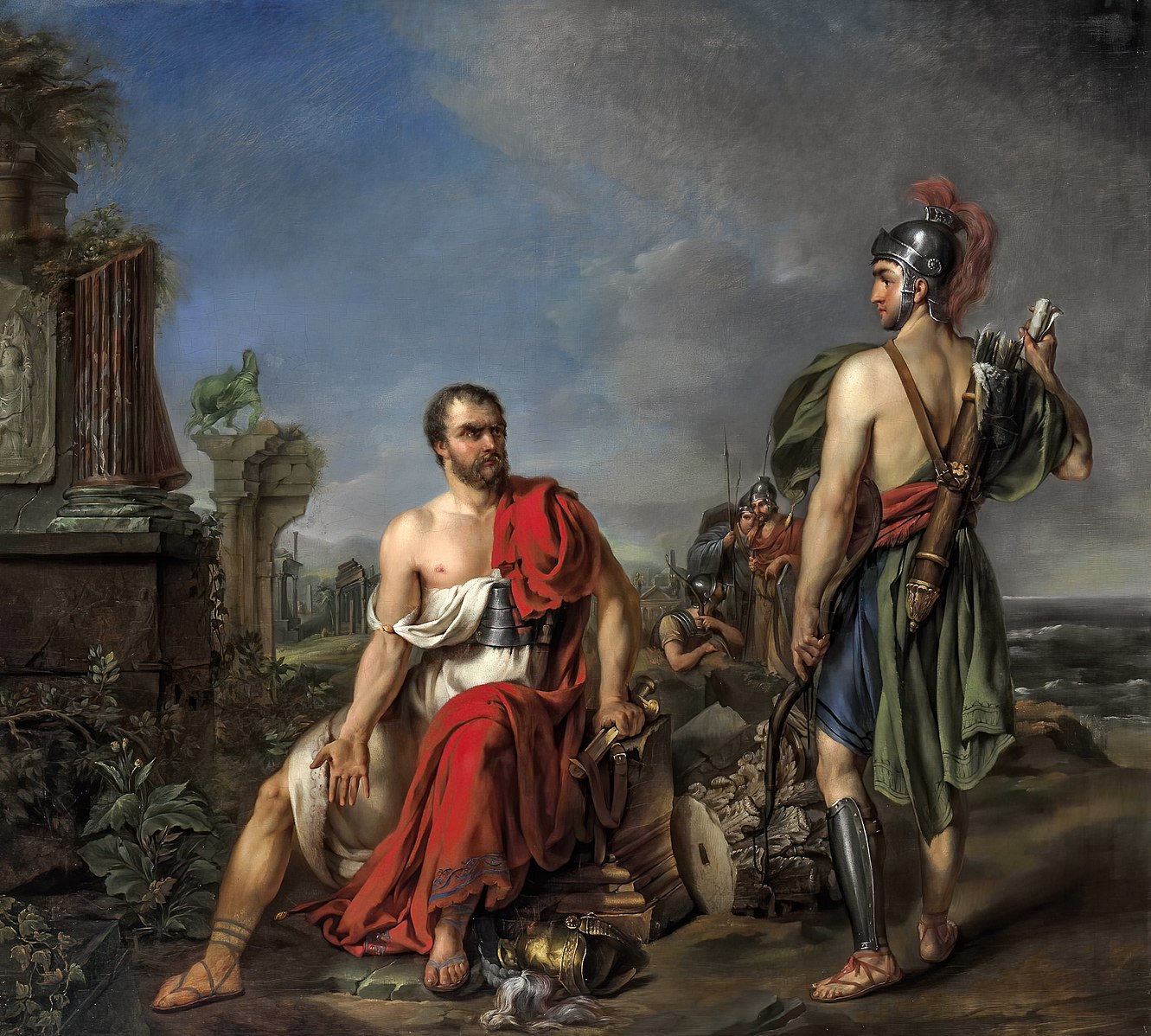
L: Sulla (?), late 1st BCE copy; R: Kremer, Exiled Gaius Marius among the Ruins of Carthage, 18th century
- Civil War, Book 2: civil war delayed, memory/flashback to civil war of Marius ("populist") & Sulla ("optimate") in 80s BCE; speech of the Old WarVeteran (2.78ff.); Pompey one of Sulla's generals, Caesar related to Marius; proscriptions & other horrors of civil war > early phase of Roman Republic's collapse
Civil War 2.189ff. (after Sulla's success: history's horrific repeatability)
“After the flesh had started to rot and turn runny
And long time had erased all means of distinction,
Rome's wretched parents came to collect the bits
They recognized and fearfully took them away.
I myself remember wanting to put the decaying face
Of my dead brother on the pyre's forbidden flames.
I wandered through the corpses that Sulla's peace
Had made, picking over the pieces, trying to find
The neck that matched his severed head . . .
. . . All these horrors await us to suffer again.
And the end of civil strife will be the same . . .”
. . . Thus the old man wept,
Mindful of the past and afraid of the future.